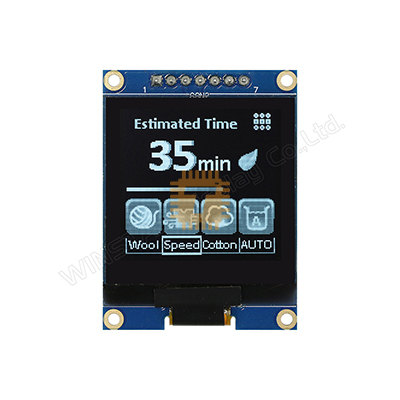
1.5 inch 128x128 OLED Shield Screen Module Blue Yellow 7-Pin for Raspberry Pi STM32 Arduino (DM0052) Products
We are sorry but the product is out of stock, please check back after few days.
| Name | 1.5 inch 128x128 OLED Shield Screen Module Blue Yellow 7-Pin for Raspberry Pi STM32 Arduino |
| Code | DM0052 |
| Price | Rs.1,850.00 |
| In Stock | No |
| Package | DISPLAY |
Product Details
The 1.5 inch 128x128 OLED Display Module is a compact, high-contrast graphic display featuring a 7-pin SPI interface. Powered by the SSD1327 driver IC, it provides a crisp 128x128 resolution in a Blue and Yellow color scheme with ultra-wide viewing angles. Its dedicated SPI pins (including CS, DC, and RST) allow high-speed data transmission and seamless integration alongside other SPI peripherals on microcontrollers and single-board computers like Arduino, STM32, and Raspberry Pi.
Specifications
- Display Size: 1.5 inches
- Resolution: 128x128 pixels
- Display Colour: Blue and Yellow
- Driver IC: SSD1327
- Interface: 4-Wire Serial Peripheral Interface (SPI)
- Viewing Angle: Greater than 160 degrees
- Operating Voltage: 3.3V to 5V DC (Wide voltage support)
- Power Consumption: Ultra-low 0.06W during normal operation (far below standard TFT displays)
- Operating Temperature: -30°C to +80°C
- Backlight: OLED self-illuminating pixels (No backlight required)
- Platform Compatibility: Supports Arduino, 8051 series, MSP430 series, STM32, Raspberry Pi, and SCR chips
Interface and Pinout Guide
- GND: Common Power and Signal Ground Reference
- VCC: Power Supply Input (3.3V to 5V DC)
- D0: SPI Serial Clock Line (CLK / SCK)
- D1: SPI Serial Data Line (MOSI)
- RST: Hardware Reset pin (Active Low)
- DC: Data / Command selection control pin
- CS: Chip Select pin (Enables multiple SPI devices on the same bus line)
Key Features
- High-Speed SPI Communication: The 4-wire SPI protocol allows faster display refresh rates compared to I2C modules, making it suitable for smooth UI animations and dynamic graphics.
- Dual-Colour Layout: Features distinct Blue and Yellow display zones to visually separate headers, status indicators, and main data readouts.
- Bus Sharing via Chip Select (CS): The dedicated CS pin enables multiplexing, allowing the display to share SPI bus lines with SD card modules or other sensors.
- Self-Illuminating OLED Technology: Every pixel generates its own light, eliminating the need for a power-hungry backlight while providing deep contrast ratios.
- Energy-Efficient Design: Consumes a tiny 0.06W during active display states, ideal for battery-powered instruments and portable IoT equipment.
Common Applications
- Smart Wearable Tech: Displaying status icons, activity metrics, and time data on custom handheld or wearable devices.
- Portable Sensor Terminals: Rendering live environmental data, graph plots, and system menus.
- Miniature Control Interfaces: Creating visual display outputs for compact CNC controllers, 3D printers, or robotics projects.
- Embedded Linux Diagnostics: Printing real-time IP addresses, memory usage, and hardware parameters on single-board computers like the Raspberry Pi.
Usage Tips
- Driver Library Selection: Ensure your graphics software library (such as U8g2 or Adafruit_SSD1327 in the Arduino IDE) is configured for the SSD1327 controller chip rather than the SSD1306 or SH1107 to ensure correct pixel mapping.
- Pin Assignment in Code: When initializing the software library, match the software SPI configuration pins accurately with your physical hardware connections for CLK, MOSI, DC, RST, and CS.
- RAM Allocation: Rendering a complete 128x128 monochrome frame buffer requires 2 KB of SRAM. On memory-constrained boards (like an Arduino Uno), use page-buffer modes within graphics libraries to optimize memory performance.
Sharing is caring, show love and share the product with your friends.