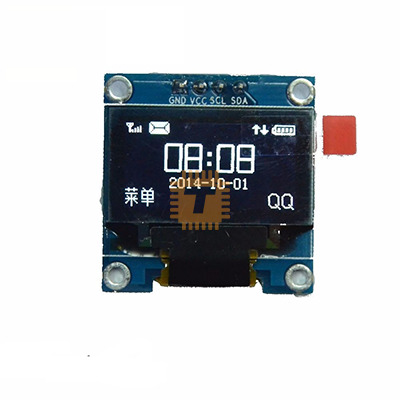
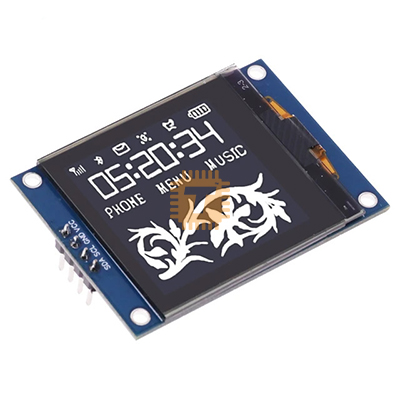
1.5 inch 128x128 OLED Shield Screen Module White 4-Pin for Raspberry Pi STM32 Arduino (DM0051) Products
We are sorry but the product is out of stock, please check back after few days.
| Name | 1.5 inch 128x128 OLED Shield Screen Module White 4-Pin for Raspberry Pi STM32 Arduino |
| Code | DM0051 |
| Price | Rs.2,000.00 |
| In Stock | No |
| Package | DISPLAY |
Product Details
The 1.5 inch 128x128 OLED Display Module is a compact, high-contrast monochrome graphic display screen. Powered by the SH1107 driver IC, it delivers a crisp 128x128 resolution with ultra-wide viewing angles. Utilizing a simple 4-pin I2C interface, it requires only two communication lines to control, making it an excellent display upgrade for space-constrained projects using microcontrollers or single-board computers like Arduino, STM32, and Raspberry Pi.
Specifications
- Display Size: 1.5 inches
- Resolution: 128x128 pixels
- Display Colour: White
- Driver IC: SH1107
- Interface: I2C (IIC) requiring only two I/O pins
- Viewing Angle: Greater than 160 degrees
- Operating Voltage: 3.3V to 5V DC (Wide voltage support)
- Power Consumption: Ultra-low 0.04W during normal operation
- Operating Temperature: -30°C to +80°C
- Backlight: OLED self-illuminating pixels (No backlight required)
- Font Engine: No hardware font chip built-in (Requires software font bitmap generation)
- Platform Compatibility: Supports Arduino, 8051 series, MSP430 series, STM32, Raspberry Pi, and SCR chips
Interface and Pinout Guide
- VCC: Power Supply Input (3.3V to 5V DC)
- GND: Common Power and Signal Ground Reference
- SCL: I2C Serial Clock Line (Connects to MCU SCL pin)
- SDA: I2C Serial Data Line (Connects to MCU SDA pin)
NOTE: If 3.3V is supplied, make sure to bridge L-SDA and L-SCL pads in the back side of the display
Key Features
- High-Density Display Area: The 128x128 square resolution offers significantly more screen real estate and vertical pixels than standard 0.96-inch (128x64) OLED modules.
- Self-Illuminating OLED Technology: Every individual pixel emits its own light, eliminating the need for a bulky backlight while achieving true pitch-black background contrast ratios.
- Minimal Microcontroller I/O Overhead: Communicates over a standard 2-wire I2C bus (SDA/SCL), saving crucial GPIO pins for other sensors and actuators.
- Low Energy Footprint: Consumes a tiny 0.04W under standard operations, making it suitable for handheld, battery-powered IoT devices and wearables.
Common Applications
- Smart Wearable Tech: Displaying time, health telemetry, or notification icons on custom smartwatch or health band builds.
- Portable Sensor Stations: Printing multi-line live environmental metrics, bar charts, and system status menus.
- Miniature User Interfaces: Rendering graphical icons and menu trees for compact handheld instruments.
- Development Diagnostics: Outputting Real-time debug logs and IP addresses on embedded Linux single-board computers like the Raspberry Pi.
Usage Tips
- Driver Library Selection: Make sure to select or initialize libraries specifically configured for the SH1107 driver IC (such as the U8g2 library in Arduino IDE), rather than standard SSD1306 drivers, as memory address mapping differs between these controllers.
- Graphics Memory Buffer: Because the screen renders 128x128 pixels, a full frame-buffer array requires 2 KB of RAM on your microcontroller. For memory-constrained boards (like an Arduino Uno), use page-buffer modes within graphics libraries to prevent running out of SRAM.
- I2C Bus Address: Check your specific breakout module's default I2C address (commonly 0x3C or 0x3D) using a standard I2C scanner code before uploading your main software sketch.
Tutorial: Simple-circuit
Sharing is caring, show love and share the product with your friends.
Featured

Add to Cart