
2-Channel 433MHz Wireless RF Remote Controller (with receiver raw data) (MD0920) Products
| Name | 2-Channel 433MHz Wireless RF Remote Controller (with receiver raw data) |
| Code | MD0920 |
| Price | Rs.950.00 |
| In Stock | Yes |
| Package | MODULE |
Product Details
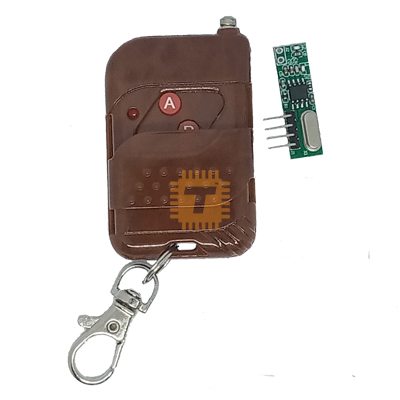
This wireless RF kit consists of a 2-button handheld transmitter and a high-sensitivity super-regenerative receiver module. Unlike "latched" or "momentary" switching modules, this receiver provides a raw data output (Vin-D0-D1-GND), making it the standard choice for projects requiring custom protocol decoding or unique ID identification via microcontrollers.
Specifications
- Operating Frequency: 433.92 MHz
- Modulation Type: ASK / OOK (On-Off Keying)
- Transmission Range: 20m – 100m (Greatly depends on antenna and obstacles)
- Receiver Sensitivity: -105dBm
- Operating Temperature: -10°C to +70°C
RF Transmitter (Handheld Remote)
- Buttons: 2 Independent Channels (A/B or 1/2)
- Power Supply: 12V (27A Alkaline Battery included)
- Encoding: Fixed Code (typically PT2262 or EV1527 compatible)
- Build: Compact keychain design with a sliding cover to prevent accidental triggers.
- LED Indicator: Bright LED lights up during transmission to confirm battery health and signal output.
RF Receiver Module (4-Pin Data)
- Voltage Supply (Vin): 5V DC (Stable 5V is recommended for maximum range)
- Current Consumption: 4mA (Quiescent)
- Data Pins (D0, D1): These pins output the raw digital bitstream. They are internally tied together on the PCB, providing the same demodulated signal for redundancy or easier routing.
- Pinout: Vin, D0, D1 (or D0), GND
- Antenna Terminal: Small "ANT" solder hole for a 17.3cm whip antenna (required for usable range).
Features
- Raw Data Output: The module passes the raw square-wave signal directly to your microcontroller. This allows you to identify unique digital codes from different remotes rather than just a simple high/low trigger.
- Microcontroller Compatible: Easily interfaces with 5V logic. For 3.3V devices (like ESP32 or Raspberry Pi), a simple voltage divider on the data pin is recommended.
- High Noise Tolerance: The super-regenerative circuit naturally filters out low-frequency interference, though the data pins will show "chatter" (high-speed random bits) when no transmitter is active.
- Compact Footprint: The receiver's small size allows it to be easily embedded into DIY home automation hubs or small IoT enclosures.
Usage Notes
- Decoding Required: Because the data pins output raw radio noise when idle, you must use a software library (such as RC-Switch for Arduino) to recognize the specific pulse-width patterns of your transmitter.
- Antenna Requirement: To achieve reliable range, you must solder a 17.3cm solid core wire to the ANT pad. For best results, keep the wire straight and away from metal objects.
- Collision Avoidance: If two remotes transmit simultaneously, the signals will collide, and the receiver will output undecipherable noise.
Sharing is caring, show love and share the product with your friends.
Featured


Add to Cart


Add to Cart
Other Products
Add to Cart
Add to Cart
Add to Cart
Add to Cart
