ADS1115 ADC 16bit Precision Module Blue Board (MD0711) Products
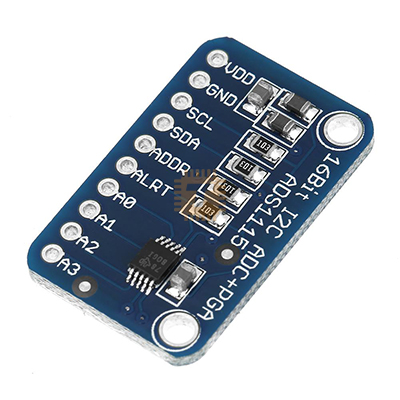
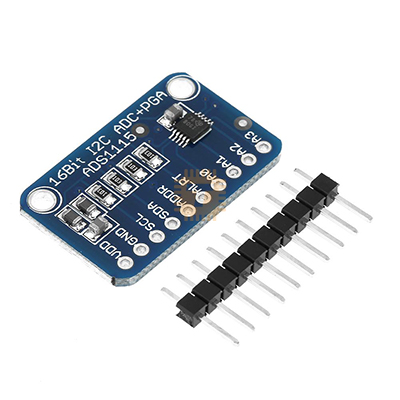
| Name | ADS1115 ADC 16bit Precision Module Blue Board |
| Code | MD0711 |
| Price | Rs.520.00 |
| In Stock | Yes |
| Package | MODULE |
Product Details
The ADS1115 is a high-precision, 16-bit Analog-to-Digital Converter (ADC) that communicates via I2C. The blue board variant is a compact breakout widely used to add or improve analog capabilities for microcontrollers like the Raspberry Pi, ESP8266, or Arduino. It provides 65,536 levels of resolution, making it significantly more accurate than the standard 10-bit ADCs found on most entry-level development boards.
Specifications
- Resolution: 16-bit
- Operating Voltage: 2.0V to 5.5V DC
- Interface: I2C with four pin-selectable addresses
- Channels: 4 Single-Ended or 2 Differential inputs
- Programmable Data Rate: 8 SPS to 860 SPS (Samples Per Second)
- Current Consumption: 150uA in continuous mode (auto power-down after conversions)
- Internal PGA: Programmable Gain Amplifier (up to x16)
- Internal Reference: Low-drift voltage reference
Features
- High Precision: With 16-bit resolution, it can detect extremely small voltage fluctuations, which is critical for scientific sensors and precise battery monitoring.
- Programmable Gain (PGA): The onboard amplifier allows you to increase the sensitivity for very small signals (e.g., measuring ±256mV across the full 16-bit range).
- Differential Measurement: Supports measuring the voltage difference between two channels, which helps cancel out common-mode noise.
- Address Selectable: By connecting the ADDR pin to GND, VDD, SDA, or SCL, you can run up to four ADS1115 modules on the same I2C bus.
- Comparator Function: Features a programmable digital comparator that can trigger the ALERT pin when a threshold is met, reducing the need for constant MCU polling.
Pin Configuration
- VDD: Power Supply (2.0V – 5.5V).
- GND: Ground.
- SCL: I2C Clock line.
- SDA: I2C Data line.
- ADDR: I2C Address select pin.
- ALRT: Programmable comparator output or conversion ready.
- A0 – A3: Analog Input channels.
Common Applications
- Battery Management: Precisely tracking cell voltages in Li-Po or Li-ion packs.
- Analog Sensor Expansion: Adding high-quality analog inputs to boards like the Raspberry Pi (which has no native ADC).
- Precision Sensing: Interfacing with thermocouples, load cells, and pressure transducers.
- Process Control: Monitoring 0-5V or 0-3.3V industrial signal lines with high granularity.
Usage Tips
- Input Voltage Safety: Ensure the voltage applied to any analog pin (A0–A3) does not exceed VDD + 0.3V to prevent permanent damage.
- I2C Addressing: The default address is typically 0x48 when ADDR is connected to GND.
- Noise Minimization: For the best 16-bit stability, keep analog signal wires short and use a decoupling capacitor (0.1uF) across the VDD and GND pins.
- Note on DAC: While often searched alongside DACs, the ADS1115 is strictly an Analog-to-Digital Converter (ADC); it does not produce an analog output voltage. For DAC functionality, the MCP4725 is a common companion.
Sharing is caring, show love and share the product with your friends.
Featured

Add to Cart


Other Products
Add to Cart