
HK32F103C8T6 HK32 ARM Minimum System Development Board Blue Pill (STM32F103C8T6 Clone) (DB0151) Products
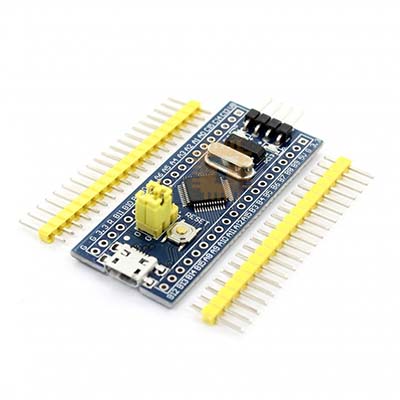
| Name | HK32F103C8T6 HK32 ARM Minimum System Development Board Blue Pill (STM32F103C8T6 Clone) |
| Code | DB0151 |
| Price | Rs.550.00 |
| In Stock | Yes |
| Package | MODULE |
Product Details
If this product is out of stock, you may consider buying the original STM32F103C8T6 STM32 ARM Minimum System Development Board Blue Pill.
The HK32F103C8T6 is a high-performance, 32-bit development board based on the ARM Cortex-M3 core, produced by HsuanKa (HK). It is a widely used "clone" or functional equivalent of the STM32F103C8T6 "Blue Pill," designed to be pin-to-pin compatible while offering similar processing power and peripheral sets at a competitive price point.
Specifications
- Core: ARM 32-bit Cortex-M3 CPU.
- Clock Speed: 72MHz maximum frequency.
- Memory: 64KB Flash and 20KB SRAM.
- Operating Voltage: 2.0V to 3.6V DC (Onboard 3.3V regulator included).
- I/O Pins: 37 GPIO pins, many of which are 5V tolerant.
- Communication: 2x I2C, 2x SPI, 3x USART, 1x USB 2.0 Full Speed, and 1x CAN 2.0B.
- ADC: 2x 12-bit Analog-to-Digital Converters.
- Programming: Supports Serial Wire Debug (SWD) and JTAG interfaces.
Features
- Drop-in Compatibility: Features the same "Blue Pill" form factor and pinout as the STM32 version, making it compatible with existing PCB designs and breadboard projects.
- 32-Bit Performance: Provides a significant upgrade over 8-bit microcontrollers (like the ATmega328P) in terms of speed, memory, and peripheral availability.
- Onboard Connectivity: Includes a Micro-USB port for power and serial communication, and a hardware Reset button.
- Boot Selection: Equipped with BOOT0 and BOOT1 jumpers to control whether the device starts from Flash, System Memory, or SRAM.
- Low Power Modes: Supports Sleep, Stop, and Standby modes for battery-efficient applications.
Pin and Header Guide
- V3 / GND: 3.3V Power and Ground pins.
- 5V: 5V Power Input (regulated onboard to 3.3V).
- SWDIO / SWCLK: 4-pin header for programming via ST-Link V2.
- PA0–PA15 / PB0–PB15: Digital and Analog I/O pins supporting PWM, ADC, and communication protocols.
- VBAT: Power input for the internal Real-Time Clock (RTC) and backup registers.
Common Applications
- Embedded Control: Managing complex robotics, motor drivers, and industrial automation tasks.
- IoT Nodes: Acting as a high-speed controller for WiFi, LoRa, or Ethernet-connected sensors.
- USB Devices: Developing custom HID peripherals such as joysticks, keyboards, or MIDI controllers.
- Education: Serving as an affordable platform for learning ARM Cortex-M3 architecture and professional firmware development.
Usage Tips
- Programming Tools: Use an ST-Link V2 programmer for the most reliable experience via the SWD header.
- Software Compatibility: While largely compatible with STM32 libraries (including Arduino IDE support), some low-level registers or timing-specific code may require minor adjustments due to variations in the HK silicon.
- Power Warning: Ensure 5V is only applied to the 5V pin; applying 5V to the 3.3V rail will damage the microcontroller.
- Logic Levels: Most GPIO pins are 3.3V but can tolerate 5V signals, but always verify specific pin labels on the datasheet before connecting high-voltage inputs.
Sharing is caring, show love and share the product with your friends.
Featured

Add to Cart


Add to Cart
Other Products

Add to Cart
Add to Cart
Add to Cart
