
Micro Limit Switch with 17mm Roller Lever 5A 125VAC-250VAC (10T85) (BU0147) Products
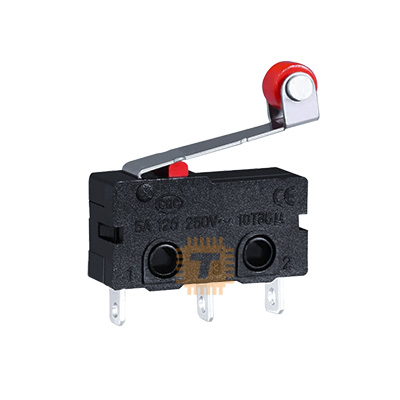
| Name | Micro Limit Switch with 17mm Roller Lever 5A 125VAC-250VAC (10T85) |
| Code | BU0147 |
| Price | Rs.40.00 |
| In Stock | Yes |
| Package | THT |
Product Details
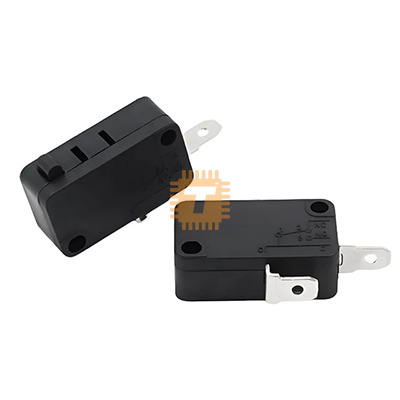
This micro limit switch (commonly referred to as a snap-action switch) is a miniature, highly sensitive electrical switch activated by a light physical force. Equipped with a 17mm metal lever arm and an integrated rolling wheel, this switch translates external mechanical motion into a crisp electrical trigger. The 10T85 stamp signifies its industrial temperature rating, making it a reliable choice for CNC machines, 3D printers, safety interlocks, and automated machinery bumpers.
Specification
- Model Rating Suffix: 10T85 (Specifies operational reliability up to 85℃ ambient temperatures)
- Maximum Electrical Load:
- 5A at 125V AC or 250V AC
- 0.4A at 125V DC or 0.2A at 250V DC
- Actuator Style: 17mm Straight Lever with a rolling wheel head
- Contact Configuration: SPDT (Single Pole Double Throw - exposes COM, NO, and NC contacts)
- Terminal Type: Standard quick-connect solder lugs
- Mechanical Lifespan: ≥ 1,000,000 cycles
- Electrical Lifespan: ≥ 100,000 cycles at full rated load
- Operating Force: Aapprox 0.5N - 1.2N (Low force actuation due to the mechanical leverage of the arm)
Features
- Rolling Lever Actuation: The integrated wheel reduces physical friction and wearing on the triggering cam or moving machine part. This allows the switch to be smoothly activated by sideways, sliding, or rotary motion, rather than just direct top-down pushes.
- Internal Snap-Action Spring Mech: Features a specialized internal beryllium-copper leaf spring. Once the lever passes a precise trip point, the contacts snap over to the opposite state instantaneously, regardless of how slow or fast the external physical actuator is moving. This limits electrical arcing and guarantees clean switching logic.
- Compact SPDT Architecture: Housing three distinct independent contact paths allows the switch to function simultaneously as a "normally open" trigger or a "normally closed" safety loop interrupt.
- Rugged 10T85 Shell: Molded out of an arc-resistant, high-temperature engineering polymer capable of running continuously in demanding environments up to 85℃.
Common Applications
- 3D Printer & CNC Homing: Serving as the structural physical X, Y, or Z-axis endstop limit marker to prevent the machine print head from crashing into the frame.
- Safety Interlock Doors: Detecting whether a laser cutter lid, microwave door, or industrial safety cage is fully closed before allowing power to reach high-voltage sub-systems.
- Vending Machine Tracking: Dropping into internal chutes to detect token slides or product drops as items roll over the lever arm.
- Automated Pneumatic Valves: Sensing the absolute extended or retracted position of pneumatic pistons and linear actuators.
Usage & Implementation Tips
- Identify Your Logic Needs (NO vs. NC):
- For homing/triggering inputs, use the COM and NO pins. The circuit sends a high signal only at the moment of impact.
- For safety/emergency stops, use the COM and NC pins. This is called a fail-safe configuration. If a wire accidentally breaks or snaps in the middle of operation, the circuit opens immediately, shutting down the machine safely before a crash occurs.
- Avoid Exceeding Actuator Over-Travel Limits: While the snap spring engages rapidly, pushing the metal lever arm far past its structural clicking point will bend the arm out of spec or crack the internal plastic chassis. Design your triggering cams to activate the roller smoothly across the face without crushing the switch body.
- Handle Solder Heat Quickly: When soldering wires directly onto the brass solder lugs, keep your iron contact time under 3 seconds at roughly 350℃. Because the switch body is small, excessive heat will travel up the pins and melt the plastic channels holding the internal contacts, shifting their alignment and ruining the switch. Use heat-shrink tubing over the lugs once cooled to prevent stray shorts.
- Mind DC Current De-rating: Note that while this switch handles up to 5A under alternating current (AC), it can only safely manage a fraction of that load under direct current (DC) rails (typically Approx 0.4A at high voltages). This is because DC currents do not cross a zero-voltage point, making electrical arcs significantly harder for small contacts to extinguish when opening. Use an intermediate relay or transistor if switching high-amperage 12V/24V DC motors.
Sharing is caring, show love and share the product with your friends.
Featured

Add to Cart

Add to Cart

Add to Cart
Other Products
Add to Cart
Add to Cart
Add to Cart
