
Original 74HC4052PW Dual 4-Channel Analog Multiplexer IC SOP-16 (IC0337) Products
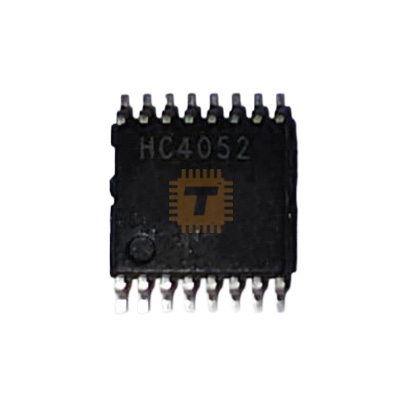
| Name | Original 74HC4052PW Dual 4-Channel Analog Multiplexer IC SOP-16 |
| Code | IC0337 |
| Price | Rs.60.00 |
| In Stock | Yes |
| Package | SMD |
Product Details
The 74HC4052PW is a high-speed CMOS device featuring two independent 4-channel analog multiplexers or demultiplexers. It is designed to handle both digital and analog signals, allowing for the switching of voltages that can swing between the positive supply (Vcc) and the negative supply (Vee). This dual-path architecture makes it an essential component for stereo audio routing, multi-channel sensor data acquisition, and signal processing in compact electronic designs.
Specifications
- Supply Voltage (Vcc): 2.0V to 10.0V
- Negative Supply (Vee): Up to -5.0V for bipolar/AC signals
- On-Resistance (Ron): Approximately 80 Ohm (Typical at Vcc - Vee = 9V)
- Bandwidth: 180MHz (Typical), suitable for high-frequency signal switching
- Logic Compatibility: Compatible with both TTL and CMOS logic levels
- Operating Temperature: Wide range from -40°C to 125°C
- Package: TSSOP-16 (often referred to in retail as SOP-16)
Features
- Bidirectional Switching: Each channel can function as either an input or an output, facilitating signal flow in both directions.
- Analog & Digital Versatility: Capable of switching analog voltages (like audio or sensor signals) as well as digital logic levels.
- Low Crosstalk: High isolation between channels (-50dB at 1MHz) ensures that signal interference between the two multiplexers is minimized.
- Break-Before-Make Switching: Features internal logic that disconnects one channel before the next is connected, preventing momentary short circuits between different signal sources.
- Logic Level Translation: The digital control interface (S0, S1, E-bar) is referenced to GND, allowing the chip to interface with standard microcontrollers even when switching bipolar signals down to Vee.
Common Applications
- Audio/Video Signal Routing: Switching between multiple stereo audio sources or video feeds in consumer electronics.
- ADC Input Expansion: Multiplexing up to 8 different sensors (4 per bank) into just two Analog-to-Digital Converter pins on a microcontroller.
- Communication Systems: Routing data lines in serial protocols like RS-232, SPI, or MIDI.
- Programmable Gain Amplifiers: Using the switch to select between different feedback resistors in an operational amplifier circuit to change gain dynamically.
Usage Tips
- Bipolar Signals: For signals that drop below 0V (such as raw AC audio), you must provide a negative voltage to Vee (e.g. Vcc = 5V, Vee = -5V). For standard 0-5V logic or DC signals, connect Vee to GND.
- Enable Pin Control: The E-bar pin is active LOW. If it is pulled HIGH, all channels are placed in a high-impedance (OFF) state, which is useful for cascading multiple multiplexers.
- Decoupling: To ensure signal integrity and minimize switching noise, place a 0.1uF ceramic capacitor close to the Vcc pin. If Vee is used for bipolar signals, it should also be decoupled to GND.
- Signal Range: Ensure the analog signal amplitude remains within the boundaries of Vcc and Vee to avoid damaging the internal ESD protection diodes.
Sharing is caring, show love and share the product with your friends.
Featured

Add to Cart


Other Products

Add to Cart

