Original SI2302 A2SHB N-Channel MOSFET SOT-23 (DI0271) Products
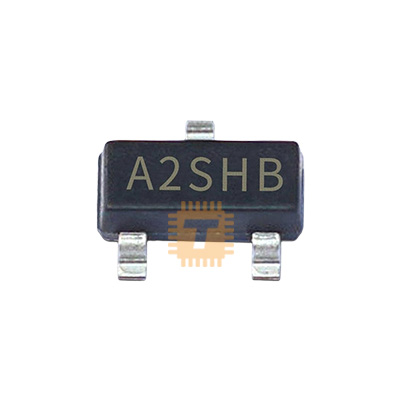
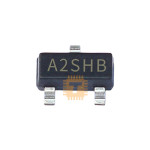
| Name | Original SI2302 A2SHB N-Channel MOSFET SOT-23 |
| Code | DI0271 |
| Price | Rs.10.00 |
| In Stock | Yes |
| Package | SMD |
Product Details
The SI2302 (marked as A2SHB) is a high-density, sub-logic level N-Channel enhancement mode field-effect transistor utilizing advanced trench MOSFET technology. Engineered to provide low on-state resistance (RDS(ON)), low gate charge, and fast switching performance within a miniature SOT-23 surface-mount footprint, it is an ideal solution for low-side load switching, power management, PWM control, and logic-level translation in battery-operated and space-constrained electronic circuits.
Specifications
- Brand / Manufacturer: Vishay Siliconix / Industry Standard
- Part Number / Marking: SI2302 / SI2302CDS / A2SHB
- Transistor Type: N-Channel MOSFET
- Drain-Source Breakdown Voltage (VDS): 20V
- Gate-Source Voltage (VGS): ±8V
- Continuous Drain Current (ID): 2.8A (at VGS = 4.5V, TA = 25°C) / 2.3A (at VGS = 2.5V)
- Pulsed Drain Current (IDM): 10A
- Low On-Resistance (RDS(ON)): < 57m>GS = 4.5V (ID = 3.6A)
- Low On-Resistance (RDS(ON)): < 75m>GS = 2.5V (ID = 3.1A)
- Gate Threshold Voltage (VGS(th)): 0.40V to 0.85V (Typical ~0.7V)
- Total Gate Charge (Qg): Approx. 3.5nC (at VGS = 4.5V)
- Maximum Power Dissipation (PD): 0.86W to 1.25W (at TA = 25°C)
- Operating Junction & Storage Temperature: -55°C to +150°C
- Package / Case: SOT-23 (TO-236) Surface Mount (Pin 1: Gate, Pin 2: Source, Pin 3: Drain)
Features
- Advanced TrenchFET Power Technology: Delivers high cell density and exceptionally low conduction losses (RDS(ON)) to minimize thermal buildup during continuous current switching.
- Sub-Logic Level Gate Drive: Fully turns ON with low gate drive voltages down to 2.5V, allowing seamless direct drive from 3.3V and 5V microcontrollers (ESP32, STM32, Arduino) without auxiliary buffer stages.
- High Current Handling in Miniature Footprint: Safely handles continuous drain currents up to 2.8A within a standard compact SOT-23 package.
- Fast Switching Speed: Low input capacitance and a low gate charge of ~3.5nC ensure quick transitions with minimal switching losses during high-frequency PWM switching.
- High Reliability & ESD Robustness: Designed for stable gate breakdown resilience and efficient heat transfer through surface-mount PCB copper traces.
Common Applications
- Low-Side Load Switches: Power gating for sub-modules, wireless radios, sensors, and displays in battery-powered IoT devices.
- DC Motor & Solenoid Drivers: Low-side switching for small DC vibration motors, cooling fans, micro-pumps, and relay coils.
- LED Dimming & Driving: High-efficiency PWM brightness control for LED strips, backlights, and status indicators.
- Bidirectional Logic Level Shifting: Standard active component in bidirectional I2C, SPI, and UART level converter circuits between 1.8V, 3.3V, and 5V systems.
- DC-DC Buck & Boost Converters: Synchronous rectification and primary power switching in low-voltage step-down/step-up topologies.
Usage Tips
- Gate Current Limiting Resistor: Insert a small series resistor (10Ω to 100Ω) between the microcontroller GPIO pin and the Gate (Pin 1) to damp high-frequency oscillation ringing and protect the MCU output from inrush charging spikes.
- Gate Pull-Down Resistor: Always place a 10kΩ to 100kΩ pull-down resistor from Gate to Source (GND) to guarantee the MOSFET stays fully OFF during MCU bootup, reset, or floating pin states.
- Inductive Kickback Protection: When switching inductive loads (such as DC motors, buzzers, or relays), place a fast-recovery flyback diode (e.g., 1N5819 Schottky) across the load to protect the MOSFET against inductive voltage spikes exceeding the 20V VDS rating.
- Gate Voltage Clamping: Ensure the Gate-to-Source differential voltage never exceeds the ±8V maximum rating; do not drive the gate directly with 12V or higher rails without a proper voltage divider.
Sharing is caring, show love and share the product with your friends.
Featured

Add to Cart


Add to Cart