
Original TLV3501 Op-Amp Operational Amplifier SOP-8 (IC0357) Products
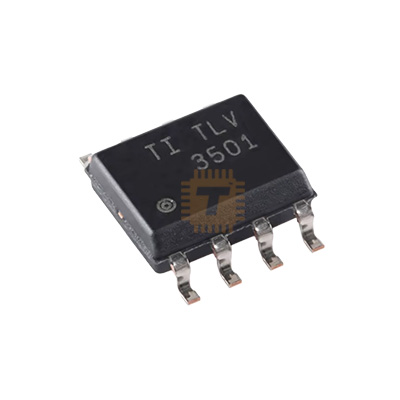
| Name | Original TLV3501 Op-Amp Operational Amplifier SOP-8 |
| Code | IC0357 |
| Price | Rs.500.00 |
| In Stock | Yes |
| Package | THT |
Product Details
The Original TLV3501 High-Speed Single-Supply Comparator (often referenced in Op-Amp / Signal Conditioning categories) is an ultra-fast, precision rail-to-rail I/O high-speed comparator integrated circuit manufactured by Texas Instruments. Encapsulated in a standard SOP-8 (SOIC-8) surface-mount package, it is engineered for high-frequency signal discrimination and waveform shaping applications. Featuring an exceptionally low propagation delay of just 4.5ns, a toggle frequency exceeding 80 MHz (up to 120 MHz in typical squaring circuits), and low power consumption of only 3.2mA quiescent current, the TLV3501 includes rail-to-rail CMOS/TTL-compatible push-pull outputs and built-in micro-hysteresis (approx. 6mV) to eliminate output oscillation when processing slow or noisy analog input signals. It is widely used in frequency meters, front-end zero-crossing detectors, high-speed pulse generators, time-of-flight (ToF) measurement circuits, line receivers, and clock-recovery front-ends.
Specifications
- Part Number / Model: TLV3501AID / TLV3501AIDR
- Manufacturer: Texas Instruments
- Device Function: 4.5ns Ultra-Fast Rail-to-Rail High-Speed Comparator
- Package Type: SOP-8
- Supply Voltage Range (Vcc / V+): Single Supply: 2.7V to 5.5V DC / Dual Supply: ±1.35V to ±2.75V DC
- Propagation Delay (tpd): Typ. 4.5 ns (at Overdrive = 20mV, Vcc = 5V)
- Maximum Toggle / Operating Frequency: > 80 MHz (Typ. 100 MHz to 120 MHz for small-signal shaping)
- Rise / Fall Time (tr / tf): Typ. 1.5 ns (20% to 80%, CL = 10pF)
- Output Type: Rail-to-Rail Push-Pull CMOS / TTL Compatible Output
- Input Common-Mode Voltage Range: -0.2V to (Vcc + 0.2V) (True Rail-to-Rail Input with Beyond-the-Rails headroom)
- Input Offset Voltage (Vos): Typ. ±1.0 mV / Max. ±5.0 mV (at 25°C)
- Built-in Input Hysteresis: Typ. 6 mV (Internal noise immunity threshold)
- Input Bias Current (Ib): Typ. 5 pA / Max. 50 pA (High-impedance CMOS inputs)
- Quiescent Supply Current (Iq): Typ. 3.2 mA / Max. 5.0 mA per channel (at Vcc = 5V)
- Output Short-Circuit Current (Isc): Typ. ±50 mA
- Common-Mode Rejection Ratio (CMRR): Typ. 70 dB to 80 dB
- Power Supply Rejection Ratio (PSRR): Typ. 80 dB
- Operating Ambient Temperature (Ta): -40°C to +125°C
- Storage Temperature Range (Tstg): -65°C to +150°C
- Pinout Configuration:
- Pin 1: No Connection (NC) / Shutdown (on specific variants)
- Pin 2: Inverting Input (IN-)
- Pin 3: Non-Inverting Input (IN+)
- Pin 4: Negative Supply / Ground (V- / GND)
- Pin 5: No Connection (NC)
- Pin 6: Output (OUT)
- Pin 7: Positive Supply (V+ / VCC)
- Pin 8: No Connection (NC)
Features
- 4.5ns Ultra-High-Speed Response: Fast propagation delay enables accurate zero-crossing detection, high-frequency squaring, and sub-nanosecond pulse discrimination up to 100+ MHz.
- Rail-to-Rail Input & Push-Pull Output: Accommodates input voltages spanning ground up to the positive supply rail, while the push-pull output drives TTL, CMOS, and high-speed MCU/FPGA inputs directly without an external pull-up resistor.
- Built-in 6mV Hysteresis: Integrated internal hysteresis prevents false triggering, multiple transitions, and output chatter caused by slow-moving analog signals or high-frequency input noise.
- Ultra-Low 5pA Input Bias: CMOS input stage presents virtually no loading to upstream high-impedance sensors, RF detectors, and tuned LC resonant tanks.
- Single-Supply 2.7V to 5.5V Flexibility: Seamlessly runs from 3.3V logic rails (STM32, ESP32, FPGA) or 5.0V systems (Arduino, 5V TTL systems) with no voltage level shifting required.
Common Applications
- High-Speed Frequency Counters & Meters: Front-end small-signal conditioning to square sine, triangle, and weak RF signals before feeding MCU timer capture pins.
- Laser Rangefinders & Time-of-Flight (ToF): Ultra-fast pulse timing discrimination for optical echo detection circuits.
- Clock Recovery & Waveform Squaring: Converting low-amplitude oscillator sine waves into clean square clock pulses with sub-nanosecond jitter.
- Zero-Crossing Detectors & Phase Meters: Precision AC zero-cross detection in power monitoring and phase angle calculation units.
- High-Speed Line Receivers: Differential and single-ended high-speed data transmission over twisted-pair cables.
Usage Tips
- Comparator vs. Op-Amp Functionality: Note that although frequently categorized alongside operational amplifiers due to its pinout, the TLV3501 is a dedicated **high-speed digital output comparator** and is not intended for linear negative feedback amplification circuits.
- Power Rail Decoupling: Due to sub-nanosecond edge rates (tr ≈ 1.5ns), high switching transients occur during state transitions. Always place a **100nF low-ESR ceramic capacitor in parallel with a 10µF tantalum/ceramic capacitor** directly between Pin 7 (V+) and Pin 4 (GND) with minimal trace length.
- Adding External Positive Hysteresis: For very noisy or millivolt-level slow signals, add external positive feedback (a 100kΩ to 1MΩ resistor between Pin 6 Output and Pin 3 Non-Inverting Input, paired with a small input series resistor) to widen the hysteresis band and prevent parasitic oscillation.
- Keep Input & Output Traces Isolated: Route high-speed output lines (Pin 6) far away from sensitive high-impedance input pins (Pin 2 and Pin 3) to prevent capacitive coupling and self-oscillation at frequencies above 50 MHz.
- Impedance Matching on Long Cables: If routing the Pin 6 output over coaxial cable or PCB transmission lines longer than a few inches, place a 50Ω series resistor at the comparator output to match transmission line characteristic impedance and suppress ringing.
Sharing is caring, show love and share the product with your friends.
Featured


Add to Cart

Add to Cart

Add to Cart
