
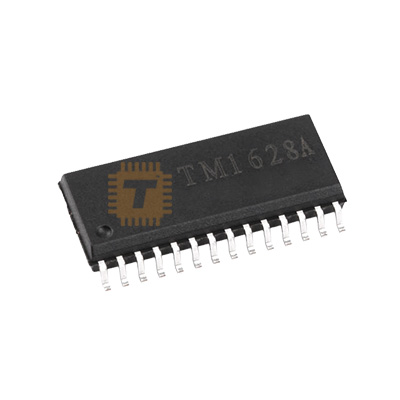
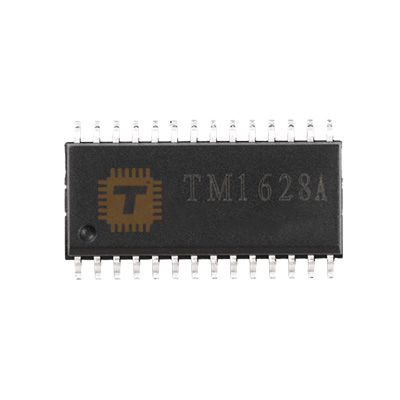
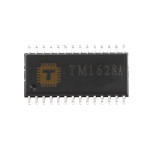
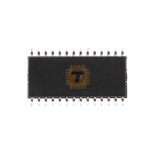
Original TM1628A LED Display Driver IC SOP-28 (IC0363) Products
| Name | Original TM1628A LED Display Driver IC SOP-28 |
| Code | IC0363 |
| Price | Rs.100.00 |
| In Stock | Yes |
| Package | SOIC-8 |
Product Details
The Original TM1628A LED Display and Key-Scan Driver IC is a dedicated peripheral controller integrated circuit manufactured by Titan Micro Electronics. Encapsulated in a standard SOP-28 surface-mount package, it combines an internal LED display memory matrix, 7-segment / 14-segment drive outputs, an 8-level digital dimming circuit, and a 10×2 matrix key-scanning interface onto a single chip. Controlled through a high-speed 3-wire serial interface (STB, CLK, DIO), the TM1628A manages multi-digit numeric LED displays or front-panel indicator arrays while offloading refresh and keypad polling tasks from the main host microcontroller (such as Arduino, ESP32, STM32, or CH32V). It is widely utilized in front-panel control boards for home appliances, induction cooktops, microwave ovens, set-top boxes, DVD/audio receivers, and industrial instrumentation panels.
Specifications
- Part Number / Model: TM1628A / TM1628
- Manufacturer: Titan Micro Electronics (TitanMicro)
- Device Function: Multi-Segment LED Display Driver & Key-Scanning Controller
- Package Type: SOP-28
- Operating Supply Voltage Range (VDD): 4.5V to 5.5V DC (Nominal: 5.0V DC)
- Logic High-Level Input Voltage (VIH): 0.7 × VDD to VDD (3.5V to 5.0V at VDD = 5V)
- Logic Low-Level Input Voltage (VIL): 0V to 0.3 × VDD (0V to 1.5V)
- Segment Output Current (High-Side Source): Typ. 20 mA to 50 mA per segment
- Grid Output Current (Low-Side Sink): Typ. 100 mA to 250 mA per grid
- Display Drive Matrix Modes:
- 10 Segments × 7 Grids
- 11 Segments × 6 Grids
- 12 Segments × 5 Grids
- 13 Segments × 4 Grids
- Key-Scan Matrix Capability: 10 × 2 Matrix (up to 20 discrete pushbuttons or switches)
- Dimming Control: 8-Level Pulse-Width Modulation (PWM) Software Brightness Adjustment (1/16 to 16/16 Duty Cycle)
- Host Communication Interface: 3-Wire Synchronous Serial Interface (STB - Strobe/Chip Select, CLK - Serial Clock, DIO - Bidirectional Data I/O)
- Serial Clock Frequency (fCLK): Up to 1 MHz
- Built-in Oscillator: Internal RC Oscillator (No external crystal or resonator required)
- Power Dissipation (Pd): Max. 400 mW
- Operating Ambient Temperature (Topr): -40°C to +85°C
- Storage Temperature Range (Tstg): -65°C to +150°C
- Pinout Configuration (SOP-28):
- Pins 1 to 4: GRID4/SEG13, GRID5/SEG12, GRID6/SEG11, GRID7/SEG10 (Configurable Grid/Segment Pins)
- Pins 5 to 7: STB (Strobe Input), CLK (Clock Input), DIO (Serial Data Input/Output)
- Pin 8: VSS (Ground / 0V Reference)
- Pins 9 to 10: KEY1, KEY2 (Keypad Matrix Scan Inputs)
- Pin 11: VDD (Positive 5V Power Supply)
- Pins 12 to 19: SEG1/KS1 to SEG8/KS8 (Segment Drivers / Key-Scan Outputs)
- Pin 20: SEG9/KS9 (Segment Driver / Key-Scan Output)
- Pin 21: VDD (Positive 5V Power Supply)
- Pins 22 to 24: SEG10/KS10, GRID1, GRID2 (Segment / Grid Output Pins)
- Pin 25: VSS (Ground / 0V Reference)
- Pins 26 to 28: GRID3, GRID4, GRID5 (Dedicated Grid Driver Pins)
Features
- Minimal Pin Count 3-Wire Interface: Requires only 3 MCU digital GPIOs (STB, CLK, DIO) to control complex multi-digit 7-segment displays and read back up to 20 front-panel keys.
- Integrated Display RAM & Auto-Scanning: Stores display segment data in internal dual-port RAM and automatically handles high-frequency LED multiplexing without consuming MCU processing cycles.
- 8-Level Software Brightness Control: Built-in hardware duty-cycle modulator adjusts screen brightness from 1/16 to 16/16 levels via simple serial commands.
- Hardware Key De-Bouncing & Scanning: Automatically scans up to a 10×2 matrix keyboard and stores button states in internal key data registers for easy serial polling.
- Flexible Segment/Grid Output Selection: Configurable drive modes allow driving common cathode LED modules, discrete bar graphs, and individual annunciator status icons simultaneously.
- Robust Noise Immunity: High-grade CMOS design engineered specifically for electrically noisy domestic appliances and high-EMC industrial environments.
Common Applications
- Home & Kitchen Appliance Panels: Front user-interface displays on induction cookers, air fryers, microwave ovens, and electric pressure cookers.
- Consumer Entertainment Devices: Display and button control panels for set-top boxes, DVD players, audio receivers, and karaoke systems.
- Industrial Timers & Process Indicators: Multi-digit panel meters, production counters, and digital thermostat displays.
- Air Conditioning & HVAC Units: Wall-mounted climate controller panels and indoor unit status screens.
- Custom Microcontroller Projects: Offloading complex multi-digit displays and keypads in Arduino, ESP32, and Raspberry Pi DIY builds.
Usage Tips
- Logic Level Shifting with 3.3V MCUs: When interfacing the TM1628A (running at 5.0V VDD) with 3.3V microcontrollers (ESP32, STM32, RP2040), place a **1kΩ to 2.2kΩ series resistor or bidirectional logic level shifter on the DIO line** to prevent 5V read-back pulses from exceeding the 3.3V MCU pin absolute ratings.
- Power Supply Decoupling (Critical): High dynamic switching currents from multiplexing LED segments can generate supply ripples. Place a **100nF ceramic capacitor in parallel with a 10µF to 47µF electrolytic/tantalum capacitor** as close as possible across VDD (Pins 11, 21) and VSS (Pins 8, 25).
- Pull-Up Resistor on DIO Line: The DIO pin operates as an open-drain/bidirectional line during data reads. Include an external **4.7kΩ to 10kΩ pull-up resistor** from the DIO line to VDD (or MCU logic rail) to ensure clean digital transitions.
- Key Matrix Diodes: If your application requires detecting multiple simultaneous key presses (multi-key rollover), place small signal diodes (e.g., 1N4148) in series with each push-button switch across the SEG/KS and KEY lines to prevent "phantom" key triggers.
- Ground Routing on PCB: Connect both VSS pins (Pin 8 and Pin 25) directly to a solid ground plane to ensure stable return currents during peak segment conduction.
Sharing is caring, show love and share the product with your friends.
Featured


Add to Cart

Other Products
Add to Cart
