PCF8574T 8-bit IO Extension Expander Module IIC I2C with Dip Switches (MD0313) Products

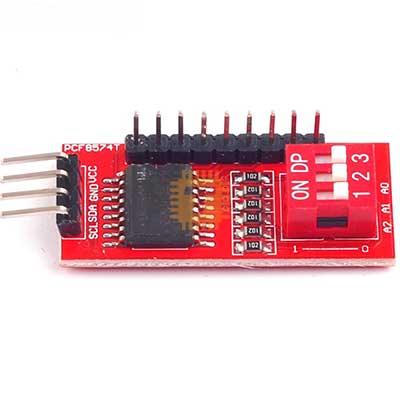
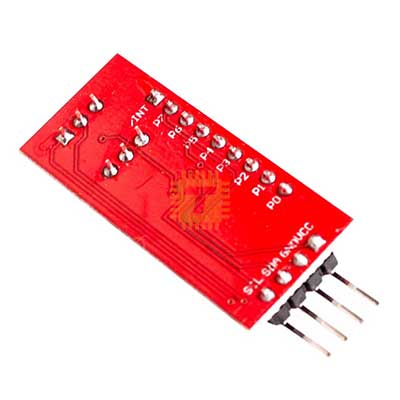
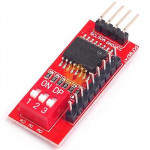
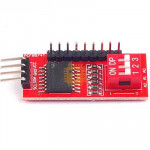
| Name | PCF8574T 8-bit IO Extension Expander Module IIC I2C with Dip Switches |
| Code | MD0313 |
| Price | Rs.280.00 |
| In Stock | Yes |
| Package | MODULE |
Product Details
The PCF8574T I/O Expander is a specialized module designed to increase the number of available digital input/output pins on a microcontroller using the I2C bus. By using only two wires (SDA and SCL), you can control up to 8 additional digital ports. This specific version features onboard dip switches, allowing for easy hardware-based I2C address configuration without the need for soldering.
Specifications
- Operating Voltage: 2.5V to 6.0V DC.
- I/O Port: 8-bit quasi-bidirectional (P0–P7).
- Interface: I2C (SCL, SDA).
- Drive Capability: Latched outputs with high-current drive for LEDs.
- Cascading Support: Up to 8 modules can be connected to the same bus.
- Total Expansion: Extend up to 64 I/O pins using 8 cascaded modules.
Operating Principles
- Quasi-bidirectional I/O: Each of the 8 pins (P0-P7) can act as an input or an output without needing a data-direction register. At power-on, the I/Os default to a "High" state.
- Addressing via Dip Switches: The module includes a 3-position toggle switch to set the I2C address. This eliminates address conflicts when multiple modules are used. For example, setting all three switches to "ON" typically sets the address to 0x27.
- Direct Drive: The outputs are designed to handle enough current to drive LEDs directly, making it an efficient choice for creating indicator panels.
Pin and Switch Configuration
- VCC / GND: Power supply input (2.5V–6V).
- SDA / SCL: I2C Serial Data and Serial Clock lines.
- P0 – P7: The 8 extended I/O pins.
- Dip Switches (1, 2, 3): Used to set the hardware address of the module.
- INT: Interrupt output (optional; goes low when an input port changes state).
Features
- Hardware Address Selection: The built-in dip switches make it simple to change the I2C address on the fly for complex projects.
- I2C Cascading: Supports connecting multiple modules in a "daisy-chain" configuration to extend a single I2C bus up to 64 pins.
- Low Power Consumption: Ideal for battery-powered or low-energy embedded systems.
- Bidirectional Flexibility: Each pin can be read as an input or written to as an output simultaneously.
Common Applications
- Keypad Matrices: Scanning large button arrays using only two microcontroller pins.
- LCD Interfaces: Standard driver for 16x2 or 20x4 character LCDs.
- LED Controllers: Managing large sets of status indicators or small LED displays.
- Industrial Control: Adding isolated digital inputs and outputs to PLC-style DIY controllers.
Usage Tips
- Power-On State: Remember that all pins start "High" upon power-up. If your load is active-low (triggered by GND), the device will be "On" as soon as power is applied.
- Pull-up Resistors: I2C requires pull-up resistors on the SDA and SCL lines. Most modules have these built-in, but ensure they are present if connecting multiple devices over long wires.
- Address Conflicts: If the module is not responding, check that the dip switch positions match the address specified in your code. Using an "I2C Scanner" sketch is a reliable way to verify the current address.
Sharing is caring, show love and share the product with your friends.
Featured

Add to Cart

Add to Cart

Add to Cart