
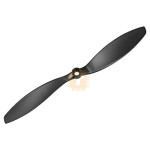
Propeller CW & CCW Pair for Quadcopter 0947 9047 9x4.7 9inch F450 (RB0375) Products
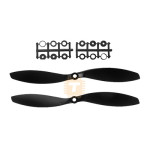
| Name | Propeller CW & CCW Pair for Quadcopter 0947 9047 9x4.7 9inch F450 |
| Code | RB0375 |
| Price | Rs.300.00 |
| In Stock | Yes |
Product Details
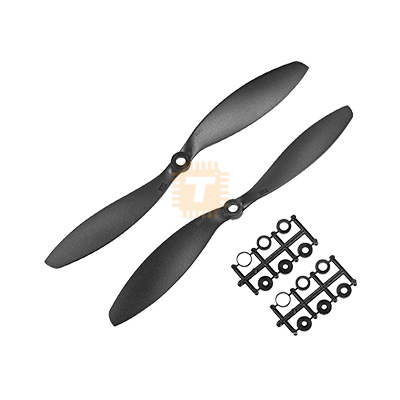
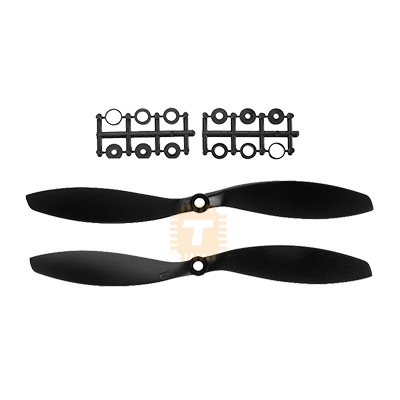
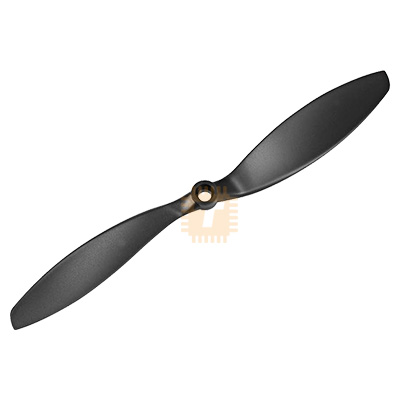
This high-efficiency 9-inch multi-rotor propeller pair comes matched as a complete set containing one Clockwise (CW) and one Counter-Clockwise (CCW) blade structure. Designed with a performance profile designated alternately as 0947, 9047, or 9x4.7, these props feature a 9-inch diameter combined with a broad 4.7-inch aerodynamic pitch curve. They are the baseline standard lifting elements for mid-sized hobby drones, custom aerial photography platforms, and standard F450 / F550 multi-rotor quadcopter builds.
Specification
- Model Geometry Designation: 9047 / 0947 / 9x4.7
- Propeller Diameter: 9 inches (approx 228.6mm)
- Thread Pitch Profile: 4.7 inches (approx 119.3mm per revolution travel distance)
- Rotational Orientation: 1x CW (Clockwise / Right-Hand Rotation) + 1x CCW (Counter-Clockwise / Left-Hand Rotation)
- Material Composition: Carbon fiber reinforced nylon / High-impact composite polymer
- Center Hub Thickness: approx 7.5mm
- Base Center Shaft Hole: approx 6.0mm to 8.0mm (Variable depending on batch)
- Adapter Ring Set Included: Ships with a plastic tree array of inner diameter adapter sizing rings (typically 3mm, 3.17mm, 4mm, 5mm, and 6mm)
- Recommended Motor Pairing: 2212 / 2213 / 2216 Brushless Outrunner Motors (800 KV to 1100 KV range)
- Target Battery Matrix Compatibility: 3S (11.1V) or 4S (14.8V) LiPo battery banks
Features
- High-Impact Reinforced Composite Body: Molded using dense, carbon-reinforced nylon sheets that minimize blade flexing under high RPM acceleration cycles. This keeps the aerodynamic profile stable, reducing structural vibration and preventing motor stalling.
- Optimized Low-Speed Thrust Winglets: The wide blade profile and high-camber curvature are specifically sculpted to move large volumes of air efficiently at lower RPM thresholds. This translates directly to extended battery life during steady, non-aggressive flights.
- Precision Hub Centering Ring Array: Packed with a modular adapter ring collection, making the props compatible with various brushless motor shaft diameters. This ensures a tight, vibration-free fit on collet-style prop adapters.
- Factory-Matched Rotational Balancing: The blades are pre-milled to ensure consistent weight distribution across both tips. This helps prevent high-frequency "jello effect" distortions in aerial video feeds caused by uneven shaft balance.
Common Applications
- F450 Quadcopter & F550 Hexacopter Builds: Serving as the definitive lift array for standard DJI-clone training frames and custom autonomous mapping drones.
- Aerial Videography Training Drones: Providing a stable, smooth hover response for budget payload frameworks carrying action cameras or lightweight tracking gimbals.
- STEM Robotics & Drone Academies: Used as a low-cost, durable instruction prop kit for university aeronautics engineering projects and custom flight controller software tuning.
- Fixed-Wing RC Park Flyers: Installed on traditional front-puller or rear-pusher RC airplanes requiring high low-speed thrust for quick vertical take-offs.
Professional Usage & Flight Safety Tips
- Strictly Verify Rotation Directions Before Take-off: Misaligning your CW and CCW propellers is the primary cause of immediate drone flips upon initial throttle up. A CW propeller belongs on a motor that rotates clockwise, and a CCW propeller (often marked with an "R" or "L" suffix on the blade face, e.g., 9047R) belongs on a counter-clockwise motor. Double-check that the raised leading edge of the blade curve slices into the rotation direction of the motor track.
- Perform Physical Propeller Balancing: Even though factory molds are highly accurate, minor composite density variations can exist. Before bolting a new set to your motors, place the prop on a magnetic propeller balancer. If one side dips downwards, apply a tiny strip of clear packing tape to the lighter blade tip until the prop rests perfectly horizontal. This step reduces bearing wear on your brushless motors.
- Match Prop Size to Battery Voltage Dynamically: If you are transitioning your drone system from a 3S (11.1V) LiPo to a higher-voltage 4S (14.8V) LiPo pack, watch your motor temperatures closely. Dropping in a higher voltage pushes more current through the coils. While a 9047 prop handles comfortably on a 1000KV motor at 3S, it may overload the motor on 4S, forcing you to step down to an 8-inch prop to avoid frying the Electronic Speed Controllers (ESCs).
- Discard Nicked or Dented Blades Immediately: Never attempt to straighten out a bent composite blade or fly with a chipped edge. The rotational forces acting on a drone prop tip can exceed several thousand RPM. A structural fracture point can cause the blade to explode mid-air under high load, causing an instantaneous, catastrophic loss of flight control.
Sharing is caring, show love and share the product with your friends.
Featured


Add to Cart
Other Products

Add to Cart
Add to Cart
