RS422 to TTL MAX490 Converter Module - Full Duplex (MD1034) Products
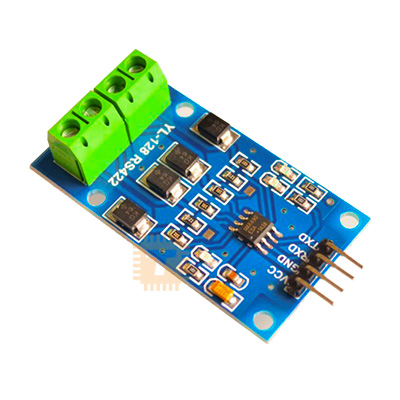
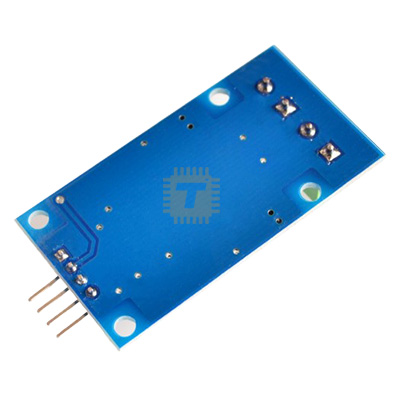
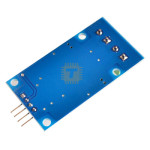
| Name | RS422 to TTL MAX490 Converter Module - Full Duplex |
| Code | MD1034 |
| Price | Rs.600.00 |
| In Stock | Yes |
| Package | MODULE |
Product Details
The MAX490 Full-Duplex RS422 to TTL Converter Module is an industrial-grade serial communication interface board designed to bridge high-speed, long-distance RS422 differential signals with standard low-voltage TTL microcontroller logic. Powered by the Maxim Integrated MAX490 transceiver IC, this module features a true full-duplex architecture, allowing data to be transmitted and received simultaneously across separate twisted-pair wires. It is a critical component for expanding the serial reach of microcontrollers (like Arduino, ESP32, or Raspberry Pi) across electrically noisy environments over long physical distances.
Specification
- Core Transceiver IC: Maxim Integrated MAX490 (High-Speed Bipolar Transceiver)
- Communication Mode: Full-Duplex (Simultaneous bidirectional data transfer)
- Logic-Side Interface: TTL / CMOS UART level (5V default operation; compatible with 3.3V systems using logic level shifters)
- Bus-Side Interface: Standard RS422 Differential Network (A, B Rx lines / Y, Z Tx lines)
- Maximum Data Rate: Up to 2.5 Mbps high-speed transmission
- Operating Supply Voltage (VCC): DC 5.0V ( ± 5%)
- Operating Supply Current: Low-power consumption (approx 300 μA typical, 500 μA max)
- On-Board Protection:
- Integrated 120Ω termination resistors for signal reflection control
- On-board TVS/ESD protection diodes (on premium module footprints)
- Wiring Terminal Forms: 4-Pin standard 2.54mm header pins (TTL) and heavy-duty screw terminals (RS422)
Features
- True Full-Duplex Bi-Directional Path: Features four independent differential lines arranged as an independent receiver pair (A/B) and transmitter pair (Y/Z). Unlike half-duplex RS485 systems, full-duplex eliminates the need for software-driven transmit/receive direction control pins (
RE/DE), letting your code operate as a standard, transparent 4-wire UART interface. - Exceptional Common-Mode Noise Rejection: The receiver circuit registers input changes based on differential voltage gaps as small as 200mV. This provides stable, error-free data parsing even when ground potentials drift wildly between connected remote machines.
- Pre-Integrated 120Ω Line Termination: The module layout comes pre-populated with surface-mount 120Ω impedance-matching resistors across the receiving differential input pairs, stabilizing high-speed data transmission edges over extended lines.
- Driver Short-Circuit & Thermal Protection: The MAX490 architecture includes internal current-limiting and thermal shutdown algorithms that protect the chip from permanent damage if the external RS422 signal wires are shorted to ground or miswired during deployment.
Common Applications
- Long-Distance Industrial Telemetry: Linking remote PLC control units, CNC controllers, or environmental sensors back to a master terminal box inside industrial plants.
- Microcontroller-to-Microcontroller Links: Creating a permanent, high-speed, long-range serial bridge between two distant development boards (e.g., connecting a roof-mounted ESP32 sensor array to an indoor home server).
- PTZ Camera Controls: Piping high-speed serial commands over long cable runs to control outdoor Pan-Tilt-Tilt industrial security cameras.
- Solar Matrix Monitoring: Aggregating real-time performance metrics from remote outdoor solar inverter arrays back to a central monitoring room.
Professional Usage & Deployment Tips
- Maintain Correct Cross-Wiring Alignment: When linking two MAX490 modules together over long distances, you must cross the transmission lines to the receiving lines. Always hook up your connections using the standard formula below:
- Module 1
Y(Tx+) -> Module 2A(Rx+) - Module 1
Z(Tx-) -> Module 2B(Rx-) - Module 1
A(Rx+) -> Module 2Y(Tx+) - Module 1
B(Rx-) -> Module 2Z(Tx-)
- Module 1
- Deploy Shielded Twisted Pair (STP) Cabling: For maximum range and noise immunity, always run your RS422 lines through standard twisted-pair cabling (such as Cat5e or Cat6 ethernet cable). Wire
AandBon one internal twisted pair, andYandZon a separate internal twisted pair. Connect the outer cable shield braid to a physical earth ground at only one end of the run to prevent creating a ground loop track. - Address 3.3V Logic Level Compatibility: The MAX490 transceiver requires a true 5V supply rail to work efficiently, and it outputs 5V logic levels on its
RXDpin. If you are interfacing this module with a 3.3V microcontroller (like a Raspberry Pi, ESP32, or STM32), you must place a logic level shifter or a simple resistor voltage divider inline along the module'sRXDpin line to drop the voltage safely, preventing damage to the host I/O pins. - Manage Termination Resistors in Multi-Drop Setups: The onboard 120Ω termination resistors are required at the absolute physical ends of an RS422 line to stop signal reflection. If you are configuring a "multi-drop" network layout where one master talks to multiple receivers along a single chain, ensure that only the very last module on the physical tail of the chain has the termination resistor active. Having multiple termination resistors wired in parallel will overload the transmitter driver, causing data dropouts.
Sharing is caring, show love and share the product with your friends.
Featured


Add to Cart

Add to Cart

Add to Cart
Other Products

Add to Cart