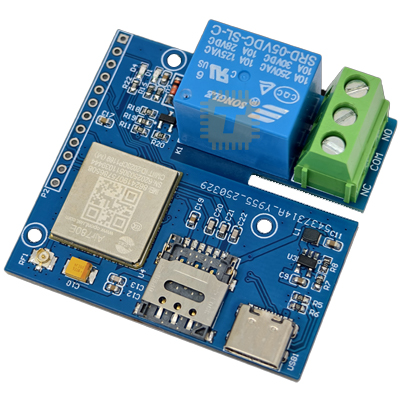
SIM800L GSM Module with Antenna v2.2 (MD0147) Products
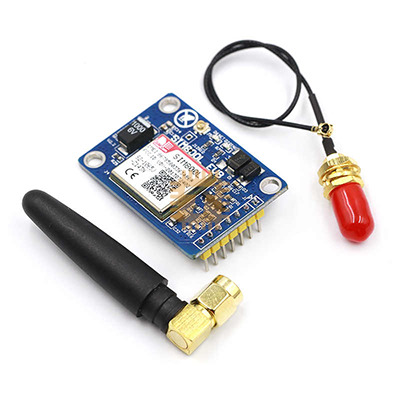
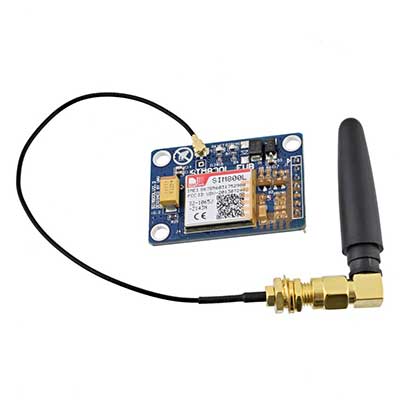
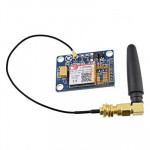
| Name | SIM800L GSM Module with Antenna v2.2 |
| Code | MD0147 |
| Price | Rs.1,650.00 |
| In Stock | Yes |
| Package | MODULE |
Product Details
The SIM800L V2.2 5V Wireless GSM/GPRS Module is a compact cellular communication board designed for direct integration with standard 3.3V and 5V microcontrollers. Unlike older v1.0 variants that required strict 3.7V–4.2V lithium battery supplies and complex logic level shifters, the V2.2 revision includes onboard 5V power regulation and a dedicated logic level reference pin (VDD). Operating on global Quad-Band GSM/GPRS networks, it supports SMS text messaging, voice calls, audio interfaces, and GPRS data transmission.
Specifications
- Core Chipset: SIM800L Quad-Band GSM/GPRS Engine
- Supported Frequencies: Quad-Band 850 / 900 / 1800 / 1900 MHz
- Input Supply Voltage: 5V DC
- Power Interface Options: 2.54mm Pin Header or Micro-USB port
- Logic Level Compatibility: 3.3V and 5V TTL compatible (via VDD reference pin)
- Serial Interface: TTL UART
- Baud Rate: Auto-baud detection (default); manually supports 2400 to 115,200 bps
- Antenna Interfaces: Standard SMA connector and IPEX / IPX micro-connector
- Voice / Audio Interface: Onboard 3.5mm audio jack for headphones/mic
- SIM Card Slot: Push-pull micro-SIM card socket
Interface and Pinout Guide
- 5V: Main 5V DC Power Supply Input (Requires at least 2A peak current capacity)
- GND: Common Ground Reference
- VDD: Logic Level Reference Voltage Pin:
- Connect to 5V when interfacing with 5V boards (e.g., Arduino Uno, Mega, Nano)
- Connect to 3.3V when interfacing with 3.3V boards (e.g., ESP32, ESP8266, STM32)
- SIM_TXD: Module Serial Data Transmit pin (Connects to MCU Serial RX)
- SIM_RXD: Module Serial Data Receive pin (Connects to MCU Serial TX)
- GND (Auxiliary): Additional ground terminal (Can remain unconnected if main GND is used)
- RST: Hardware Reset pin (Active Low; leave floating if unused)
Key Features
- Direct 5V Power Support: Features an onboard step-down regulator circuit that allows direct powering from a standard 5V power supply or Micro-USB cable without external diode or buck converter drops.
- Universal Microcontroller Compatibility: The onboard VDD level translator automatically adapts the UART transmit and receive signal thresholds to match either 3.3V or 5V logic architectures.
- Dual Antenna Options: Equipped with an IPEX micro-connector for compact internal antennas and an SMA connector for high-gain external whip antennas.
- Integrated 3.5mm Audio Jack: Provides direct plug-and-play connections for headsets, earphones, and microphones to handle cellular phone calls without custom analog wiring.
- High-Quality PCB Construction: Built on a gold-plated immersion PCB with onboard over-voltage and reverse-polarity protection to safeguard internal components during prototyping.
Common Applications
- Automated SMS Notifications: Sending text alerts for industrial equipment faults, security trips, and power outages.
- Remote IoT Telemetry: Transmitting sensor readings to remote HTTP/MQTT servers over 2G GPRS data links.
- Cellular Car Alarms & Asset Trackers: Sending vehicle location data and receiving SMS commands to immobilize engines or trigger sirens.
- Emergency Intercoms & Remote Gate Openers: Answering incoming phone calls or using caller-ID switching to trigger electric gates and barriers.
Usage Tips
- Power Supply Sizing (Peak Current): GSM modules draw sudden current bursts up to 2A during network registration and RF transmission bursts. Ensure your 5V power adapter or power rail can supply at least 2A continuously; powering solely from a computer's USB 2.0 port (limited to 500mA) will cause brownout reboot loops.
- VDD Connection is Mandatory: Always connect the VDD pin to your microcontroller's operational logic voltage (5V or 3.3V). Leaving VDD disconnected will prevent the UART voltage translator from driving the serial lines, resulting in no serial response.
- Network Status LED Diagnostics:
- Fast blinking (~every 1s): Searching for a cellular network.
- Slow blinking (~every 3s): Successfully registered and connected to the GSM network.
- Very fast blinking (~every 0.3s): GPRS data connection is active.
Sharing is caring, show love and share the product with your friends.
Featured

Add to Cart


Add to Cart

Other Products
Add to Cart

Add to Cart