
Solder Wire Lead Roll 60/40 1.6mm per meter (TA1837) Products
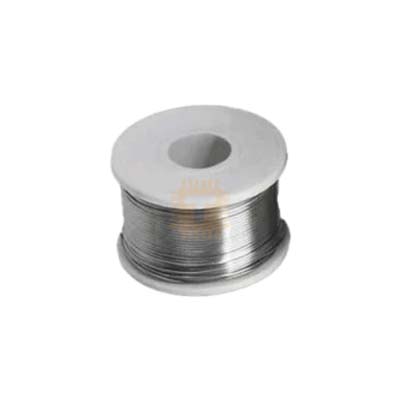
| Name | Solder Wire Lead Roll 60/40 1.6mm per meter |
| Code | TA1837 |
| Price | Rs.210.00 |
| In Stock | Yes |
| Package | SOLDER |
Product Details
The Solder Wire Lead Roll 60/40 1.6mm per meter (1.6mm Extra-Heavy Gauge / Sold Per Meter) is a heavy-duty electrical soldering alloy offered in custom linear lengths for low-volume industrial repairs, high-current electrical terminations, DIY battery building, and prototyping tasks that do not require a full spool. Formulated with the standard 60% Tin (Sn) and 40% Lead (Pb) metallurgical ratio, it features a low melting range (183°C–190°C) with a narrow plastic transition phase, ensuring rapid liquefaction, smooth capillary wetting, and strong mechanical bonding. Featuring an integrated, non-corrosive multi-channel rosin flux core (1.8%–2.2%), its heavy 1.6mm gauge delivers substantial solder volume per feed stroke, making it ideal for large wire splices, high-power battery lugs, solid copper busbars, and motor rewinding.
Specifications
- Alloy Composition: 60% Tin (Sn) / 40% Lead (Pb)
- Wire Diameter: 1.6 mm (±0.05 mm / Extra-Heavy Industrial Gauge)
- Unit of Sale: Per Meter (Continuous linear length cut to order)
- Weight per Meter: Approx. 17.0 g to 17.5 g per meter
- Flux Type / Core: Continuous Integrated Rosin Activated (RA) / Mildly Activated (RMA) Core
- Flux Content / Percentage: 1.8% to 2.2% (By weight)
- Melting Temperature Range:
- Solidus: 183°C (361°F)
- Liquidus: 190°C (374°F)
- Recommended Iron Tip Temperature: 350°C to 400°C (662°F to 752°F)
- Density: Approx. 8.5 g/cm³
- Electrical Conductivity: Approx. 11.5% to 12% IACS
- Flux Residue Characteristics: Light amber, transparent, non-conductive, non-corrosive under normal ambient conditions
- Packaging: Coiled bundle in sealed protective zip-lock / poly bag
Features
- Cost-Effective Per-Meter Option: Allows technicians, hobbyists, and students to purchase only the exact length required for specific heavy-duty projects without investing in bulk 1kg spools.
- Extra-Heavy 1.6mm Gauge: Dispenses high solder volume rapidly in a single feed motion, minimizing heating dwell time on high-dissipation joints and heavy metal connectors.
- Low Melting Point & Fast Capillary Action: Liquefies cleanly at ~185°C to flood stranded wire cores, large grounding straps, and heavy sheet metal joints without scorching adjacent insulation.
- Continuous Multi-Channel Rosin Core: Formulated with deoxidizing rosin flux that cleans surface oxides on copper, brass, tin, and nickel plating on contact without requiring external paste flux.
- Robust Mechanical & Vibration Resistance: Solidifies into thick, crack-resistant, shiny fillets with high shear strength and low contact resistance.
Common Applications
- Heavy Battery & Inverter Wiring: Splicing and tinning 4 AWG to 8 AWG power cables, off-grid solar battery lugs, and high-current terminal connections.
- High-Power Connectors: Soldering high-current XT90/EC5 plugs, Anderson Powerpole contacts, heavy banana plugs, and ground binding posts.
- Electric Motor & Transformer Repair: Terminating thick magnet wire coils, stator leads, and heavy transformer winding taps.
- Industrial Power Switchgear: Soldering solid copper busbars, heavy grounding rods, knife switches, and industrial contactor terminals.
- Stained Glass & Sheet Metal Work: Rapid filling and soldering of wide lead came channels, zinc border came, brass sheet fabrications, and copper heat exchangers.
Usage Tips
- Soldering Iron Power Requirement: Due to the large 1.6mm wire diameter and massive thermal mass of the target joints, use a high-power soldering iron or station rated at 80W to 150W+ (or direct mains heavy irons) fitted with a wide chisel or wedge tip (5mm–10mm).
- Temperature Setting: Maintain soldering tip temperatures between 360°C and 390°C to ensure fast liquefaction and uniform capillary flow into thick stranded wire bundles.
- Feeding Technique: Pre-heat the terminal and wire bundle together for 2–4 seconds until hot, then feed the 1.6mm solder directly into the joint junction until the strands are completely wetted and saturated.
- Flux Residue Cleaning: The rosin residue is electrically non-conductive and protective, but can be removed for aesthetic cleanliness using Isopropyl Alcohol (IPA ≥ 99%) with a stiff bristle brush.
- Safety & Ventilation:
- Soldering heavy joints with 1.6mm wire produces visible flux fumes; always work in a well-ventilated space or use an active benchtop fume extractor.
- Contains lead; wash hands thoroughly with soap and water after handling, and avoid eating or drinking in the workspace.
Sharing is caring, show love and share the product with your friends.
Featured

Add to Cart


Add to Cart

Other Products


Add to Cart
Add to Cart

