
UV Curable PCB Solder Mask Ink Black ZWG-UV-600 (TA1914) Products
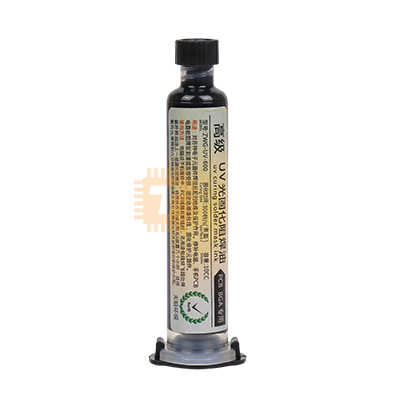
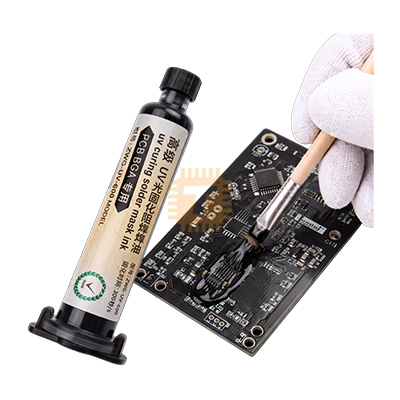
| Name | UV Curable PCB Solder Mask Ink Black ZWG-UV-600 |
| Code | TA1914 |
| Price | Rs.370.00 |
| In Stock | Yes |
| Package | ACC |
Product Details
The UV Curable PCB Solder Mask Ink Black ZWG-UV-600 is an industrial-grade, single-component liquid photoimageable polymer resin engineered for printed circuit board fabrication, trace insulation, jumper wire anchoring, and PCB solder mask repair. Formulated to polymerize and cross-link rapidly under exposure to ultraviolet (UV) radiation or direct sunlight, it forms a durable, heat-resistant, and dielectric protective barrier over bare copper traces. With high resistance to molten solder during soldering and wave-soldering processes, along with resilience against aggressive flux cleaning solvents, it prevents solder bridging between fine-pitch pads, shields copper from atmospheric oxidation, and delivers a sleek, light-blocking matte/gloss black finish ideal for concealing proprietary circuitry, matching modern black motherboards, and electronics rework.
Specifications
- Product Model / Series: ZWG-UV-600 Series
- Chemical Formulation: Single-Component Acrylate UV-Curable Liquid Photopolymer (Solvent-free formulation)
- Color / Finish: Deep Solid Black (High-opacity, light-absorbing protective film)
- Container Packaging: Dispenser Syringe Barrel (Includes push plunger and precision dispensing needle tip)
- Net Volume / Weight: Approx. 10 cc (10 ml / ~10 g to 12 g)
- Curing Wavelength Spectrum: UV-A Spectrum, 365 nm to 405 nm (Optimal peak around 395 nm)
- Curing Time:
- High-Power Benchtop UV Curing Lamp / LED (~395 nm, 10W–30W): 20 to 45 seconds
- Handheld Portable UV Flashlight (3W–5W): 90 to 180 seconds (due to high carbon pigment absorption)
- Direct Solar Exposure: 10 to 25 minutes (under intense direct sunlight)
- Viscosity: 100 to 200 Pa·s (Thixotropic paste, spreads smoothly under squeegee or needle tip)
- Dielectric Breakdown Strength: ≥ 500 V/mil (≥ 20 kV/mm)
- Insulation Resistance: ≥ 1.0 × 10¹² Ω (After complete UV polymerization)
- Solder Heat Resistance: Withstands up to 260°C to 280°C for ≥ 10 to 20 seconds (Safe for standard wave, reflow, and hand-soldering contact)
- Solvent & Chemical Resistance: Resistant to Isopropyl Alcohol (IPA), acetone, rosin solvents, ultrasonic wash detergents, and mild acids
- Adhesion Rating: Class 1 / 100% Cross-Cut Tape Test passing on degreased copper-clad laminate and FR4 epoxy
- Shelf Life: Approx. 12 months when stored sealed in a cool, dark environment (0°C to 10°C)
- Gross Package Weight: Approx. 25 g
Features
- Rapid UV Photopolymerization: Cures under a 395nm UV light source into a rigid, non-tacky protective film, providing rapid turnaround for trace repairs and board restoration.
- Total Optical Masking & IP Protection: Deep black pigmentation blocks light penetration, obscuring proprietary circuit trace routing, component jumpers, and silicon part markings from visual reverse engineering.
- Seamless Aesthetic Integration: Matches the factory finish of modern black consumer electronics motherboards (such as iPhones, MacBooks, gaming GPUs, and drone flight controllers) for discreet repairs.
- Exceptional Thermal Shock Resistance: Fully cured resin withstands direct contact with 260°C+ molten solder and hot-air rework airflow without charring, bubbling, or peeling away from the copper substrate.
- High Dielectric Isolation: Provides a non-conductive boundary that eliminates stray capacitance, short-circuits, and dendritic copper growth between high-density SMD traces.
- Solvent & Cleaner Immersion Safe: Unaffected by post-soldering defluxing chemicals, surviving ultrasonic wash cycles with 99% Isopropyl Alcohol without softening or dissolving.
Common Applications
- Black Motherboard Micro-Soldering: Insulating and mechanically tacking down 0.01mm–0.1mm enameled jumper wires on modern black smartphone, laptop, and gaming console logic boards.
- Torn PCB Pad & Trace Restoration: Rebuilding delaminated circuit traces, broken vias, and lifted solder pads damaged during component desoldering or physical impact.
- Optical Enclosure & Sensor Masking: Coating sensor PCBs and optical enclosures where stray ambient light reflections or internal board reflections must be absorbed.
- Black-Themed Custom PCB Prototyping: Applying a custom matte/gloss black protective solder mask over home-etched or CNC-milled copper boards using a transparency film photomask.
- BGA Underfill & Edge Sealing: Insulating exposed ground planes and nearby passive components before installing replacement BGA chips to prevent accidental solder bridges.
Usage Tips
- Surface Preparation (CRITICAL):
- Ensure the target copper or FR4 surface is completely clean, deoxidized, and degreased prior to application.
- Clean the repair zone thoroughly with 99% Isopropyl Alcohol (IPA) and let it evaporate fully. Any leftover rosin flux, finger oils, or moisture will prevent the mask from adhering, causing it to flake off after curing.
- Application & Layer Thickness (Black Pigment Curing Rule):
- Apply only a very thin, micro-meter level layer over the target area.
- Because carbon black pigment absorbs broad-spectrum UV radiation rapidly, UV light cannot penetrate thick layers easily. Applying too thick of a blob will leave soft, liquid resin trapped beneath a hardened surface crust. For deeper repairs, build up the thickness using several ultra-thin coats, curing each coat fully with UV light before adding the next.
- Extended UV Exposure:
- Hold the 395nm UV lamp or torch 1 cm to 2 cm away from the board for 30 to 60 seconds (allowing slightly longer exposure times than green or red inks due to pigment density).
- Verify polymerization by lightly probing the edge with fine tweezers to ensure the core has hardened completely before applying heat or solvent.
- DIY PCB Mask Exposure with Film (Photolithography):
- Spread the black ink evenly across the board and place a clear plastic film (such as an acetate transparency sheet) over it to smooth it flat without air bubbles.
- Overlay your negative pad artwork (where pads are blacked out and traces are clear), expose it under a UV lamp for 80 to 120 seconds, peel off the transparency, and wash away the soft, unexposed pad areas using an alcohol wipe.
- Storage & Eye Safety Guidelines:
- Store the syringe in a refrigerator or cool, dark cabinet (5°C to 20°C) with the black protective cap tightly fitted on the tip. Keep it completely shielded from ambient daylight to avoid premature hardening inside the needle.
- Wear certified UV-blocking safety glasses when curing the resin to protect your eyes from intense ultraviolet reflections emitted by high-power UV curing lamps.
Sharing is caring, show love and share the product with your friends.
Featured

Add to Cart

Add to Cart


Other Products

Add to Cart

Add to Cart

Add to Cart
