Vero Board Dot Epoxy FR4 15x9cm (TA1839) Products
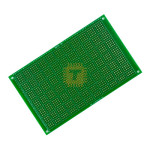
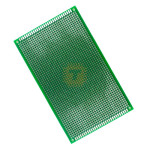
| Name | Vero Board Dot Epoxy FR4 15x9cm |
| Code | TA1839 |
| Price | Rs.290.00 |
| In Stock | Yes |
| Package | ACC |
Product Details
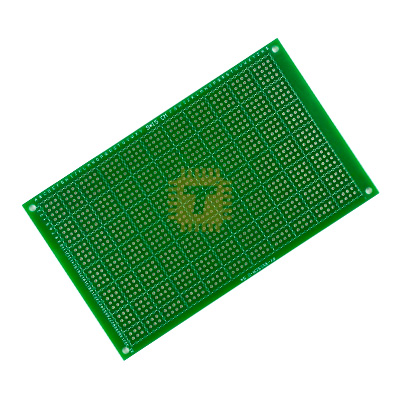
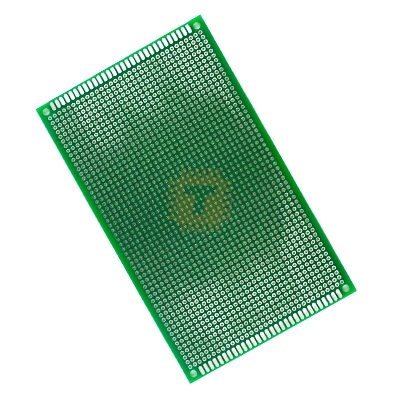
The Vero Board Dot Epoxy FR4 15x9cm is a high-grade, industrial-spec universal prototyping circuit board engineered for permanent circuit builds, embedded microcontroller systems, power electronics prototyping, and rugged DIY projects. Manufactured from high-density, flame-retardant FR-4 woven fiberglass with a standard 1.6mm thickness, it offers superior mechanical rigidity, high dielectric breakdown strength, and extreme moisture resistance compared to standard paper-phenolic (bakelite) perfboards. Featuring an individual pre-tinned copper pad dot matrix arranged on a standard 2.54mm (0.1") pitch grid with alphanumeric coordinate indexing, it facilitates easy placement and reliable hand-soldering of through-hole DIP ICs, passive components, terminal blocks, and discrete modules.
Specifications
- Board Type: Universal Dot Matrix Prototyping PCB / Perfboard / Vero Board
- Base Substrate Material: High-Density FR-4 Epoxy Woven Glass-Fiber (Flame Retardant)
- Flame Retardancy Rating: UL94V-0
- Board Dimensions: 150 mm × 90 mm (15 cm × 9 cm / Approx. 5.9" × 3.54")
- Board Thickness: 1.6 mm (±0.1 mm / Standard Rigid Spec)
- Hole Grid Spacing (Pitch): Standard 2.54 mm (0.1 Inch center-to-center)
- Hole Diameter: Approx. 1.0 mm (±0.05 mm / Fits standard component leads and pin headers)
- Matrix Layout: Individual Solder Pads (Dot-to-Dot / Island Matrix)
- Grid Dimensions: Approx. 55 Columns × 33 Rows (~1,815 Total Plated Tie Points)
- Pad / Copper Layer: Single-Sided High-Purity Copper Foil (~35 μm / 1 oz Copper)
- Pad Surface Finish: HASL (Hot Air Solder Leveling) Lead-Free Pre-Tinned Surface for rapid solder wetting
- Coordinate Grid Indexing: Screen-printed alphanumeric row/column reference markers along borders
- Corner Mounting Holes: 4 pre-drilled M3 screw mounting holes (Approx. 3.0 mm to 3.2 mm diameter)
- Dielectric Strength: ≥ 30 kV/mm
- Operating Temperature Rating: -40°C to +130°C
- Net Weight: Approx. 38 g to 45 g
Features
- Premium FR-4 Glass-Fiber Construction: Resists warping, high thermal stress, mechanical flexing, and moisture absorption—far outlasting brittle paper-phenolic boards.
- Individual Isolated Pad Matrix: Independent copper pads eliminate the risk of accidental short circuits across adjacent tracks, providing complete freedom for point-to-point jumper wire routing.
- Pre-Tinned Solder Pads (HASL): High-solderability tinned pads enable instant solder flow, reducing thermal dwell time and preventing pad delamination during repeated soldering or component rework.
- Alphanumeric Grid Indexing: Clearly labeled rows and columns allow fast coordinate referencing, simplifying schematic-to-board layout translation and debugging.
- Standard Breadboard Pitch (2.54mm): Directly accommodates DIP microcontrollers (e.g., ATmega328, PIC), standard IC sockets, pin headers, transistors, sensors, and passive components.
- Pre-Drilled M3 Corner Mounting Holes: Integrated mounting points allow rigid standoff installation into project boxes, chassis panels, and 3D-printed enclosures.
Common Applications
- Permanent Prototyping: Transitioning temporary solderless breadboard circuits (Arduino, ESP32, STM32 projects) into permanent, vibration-resistant boards.
- Power Supplies & Inverters: Assembling custom linear/switching power supplies, bridge rectifiers, and voltage regulator breakout boards.
- Audio Amplifiers & Tone Control Stages: Building discrete transistor preamplifiers, headphone amps, and filter networks with minimal parasitic hum.
- Relay & Motor Driver Modules: Mounting heavy power relays, flyback diodes, terminal blocks, and optocouplers for automation setups.
- Educational STEM & Lab Projects: Practicing high-reliability through-hole soldering techniques in university electronics and robotics labs.
Usage Tips
- Point-to-Point Wiring Technique: Because this board features individual isolated pads rather than continuous copper strips, use tinned solid copper bus wire (22–24 AWG) or insulated silicone jumper wire on the bottom solder side to link connection nodes between components.
- Pad Overheating Prevention: While FR-4 substrate has high bond strength, prolonged soldering iron contact (>5 seconds at >360°C) can cause pad lifting. Maintain iron temperature at 320°C–340°C and complete each joint within 2–3 seconds.
- Cutting & Resizing: To trim the board into smaller custom shapes, use a PCB guillotine shears, rotary tool with a diamond cutting wheel, or a fine-toothed hacksaw. Always wear a dust mask and safety goggles to avoid inhaling airborne fiberglass dust.
- Power Rail Routing: Create dedicated high-current ground (GND) and positive power (VCC) rails along the outer perimeter rows using thick solid copper wire to minimize ground impedance and voltage drops.
- Post-Soldering Cleaning: Clean away rosin flux residues using Isopropyl Alcohol (IPA ≥ 99%) and an ESD-safe brush to achieve an inspection-ready finish and prevent long-term contamination.
Sharing is caring, show love and share the product with your friends.
Featured


Add to Cart

Other Products
Add to Cart