CAT6 Keystone Jack Premium Line Unshielded Dual Type IDC White 90 degrees RJ45 Ethernet (Made in Germany) (TA1809) Products
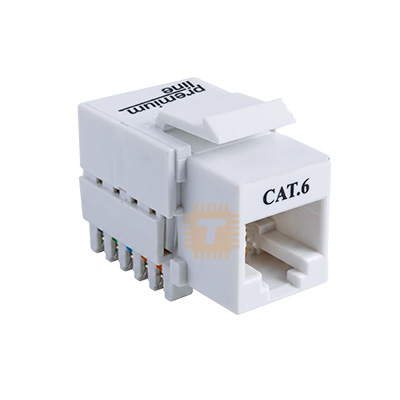
| Name | CAT6 Keystone Jack Premium Line Unshielded Dual Type IDC White 90 degrees RJ45 Ethernet (Made in Germany) |
| Code | TA1809 |
| Price | Rs.900.00 |
| In Stock | Yes |
| Package | NETWORK |
Product Details
This premium CAT6 Unshielded UTP Keystone Jack is a high-performance network module engineered to strict German quality standards. Featuring a 90℃ right-angle physical profile and a versatile Dual-Type IDC (Insulation Displacement Connector) tower block, this jack is designed for clean, rapid terminations in high-density network setups. It fits perfectly into standard wall faceplates, surface mount boxes, and modular patch panels, delivering flawless gigabit data transfer rates with high noise immunity.
Specification
- Product Type: RJ45 Keystone Jack (Category 6 Channel & Component Certified)
- Shielding Type: UTP (Unshielded Twisted Pair)
- Orientation: 90℃ Angled Wire Entry
- IDC Block Type: Dual Type IDC (Compatible with both Krone and 110 punch-down tools)
- Conductor Wire Gauge: Accommodates 22 - 26 AWG solid or stranded copper wires
- Data Transmission Speeds: Up to 1 Gbps (Gigabit Ethernet) and 10 Gbps at short runs
- Maximum Bandwidth: 250MHz
- Contact Plating: 50 μm heavy-duty gold plating over nickel
- Wiring Standard: T568A and T568B universal color-coded labels
- Housing Material: Flame-Retardant, High-Impact Thermoplastic (Color: Signal White)
- Manufacturing Standard: Engineered / Made in Germany
Features
- Universal Dual-Type IDC Blocks: The rear termination towers are uniquely configured to accept both 110-style and Krone-style punch-down blades. This eliminates the need for installers to swap tools or blades out in the field.
- 90-Degree Punch-Down Profile: The wire termination tower sits perpendicular (90℃) to the RJ45 port face. This design naturally guides the horizontal cable entry downward or upward, drastically reducing back-box depth requirements behind walls and preventing tight cable crimping.
- 50-Micron Gold-Plated Contacts: The female RJ45 plug pins feature thick gold electroplating. This protects the contact points against oxidation caused by humidity while ensuring low electrical resistance across thousands of patch cord insertion cycles.
- Integrated Wire Strain Relief Cap: Includes a snap-on plastic retention cap that locks down over the completed punch-down block, physically pinning the wires into the IDC slots to protect them from vibration, dust, or accidental pull strain.
Common Applications
- Structured Wall Faceplates: Snapping into Euro II, UK standard (86 x 86mm), or US style wall plates to create clean, localized office data outlets.
- Unshielded Modular Patch Panels: Loading into blank 24-port or 48-port 1U patch bays within telecom distribution server racks.
- Under-Desk Consolidation Boxes: Populating surface-mount junction boxes hidden under raised flooring or commercial workstation desks.
- Smart Home Media Hubs: Terminating home-run structured lines inside central residential networking cabinets.
Professional Usage & Deployment Tips
- Maintain a Minimal Pair Untwist: When prepping your solid-core network cable, do not untwist the internal wire pairs more than 0.5 inches (13mm) from the IDC point. Keeping the pairs tightly twisted right up to the punch-down terminal minimizes Near-End Crosstalk (NEXT) and preserves full CAT6 bandwidth capacities.
- Use a Keystone Punch-Down Stand: Always place the module inside a plastic pocket-sized punch-down puck or jack stand when applying pressure with your impact tool. Punching down directly into your palm can cause slips, leading to hand injuries or cracked plastic latch housings.
- Match the Wiring Standard: Ensure both ends of the run use the same wiring schematic. Look closely at the color-coded matrix printed on the side of the jack housing, and consistently select either T568B (most common in commercial environments) or T568A.
- Engage the Cut-Side Properly: When positioning your impact tool, verify that the blade's "CUT" side is facing outward away from the center of the jack. Striking with the cut blade facing inward will slice the internal circuitry of the module, instantly ruining the terminal.
Sharing is caring, show love and share the product with your friends.
Featured

Add to Cart

Add to Cart

Add to Cart