
CH32V003 Nano Development Board RISC-V Type-C (DB0153) Products
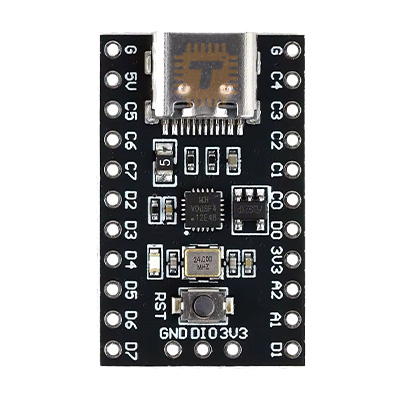
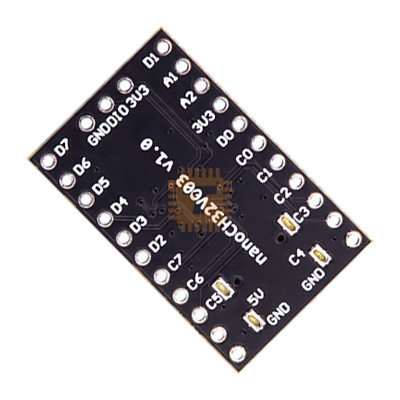
| Name | CH32V003 Nano Development Board RISC-V Type-C |
| Code | DB0153 |
| Price | Rs.650.00 |
| In Stock | Yes |
| Package | MODULE |
Product Details
The CH32V003 Nano Development Board RISC-V Type-C is an ultra-low-cost, entry-level microcontroller development board built around the WCH (WinChipHead) CH32V003F4P6 32-bit RISC-V microcontroller. Featuring an modern reversible USB Type-C connector for 5V power input and a compact breadboard-friendly form factor, it exposes all primary GPIOs, analog inputs, and serial communication buses onto dual 2.54mm pitch pin headers. Powered by the QingKe 32-bit RISC-V2A core operating at clock frequencies up to 48 MHz, the board integrates 16KB of Flash memory, 2KB of SRAM, a 10-bit ADC, a 1-Wire Single-Wire Serial Debug Interface (SDI), and multiple advanced timers. It serves as an ultra-economical, high-performance alternative to traditional 8-bit microcontrollers (like the STM8S003 or ATmega328P) for IoT nodes, sensor interfaces, DIY robotics, educational STEM kits, and high-volume embedded control systems.
Specifications
- Core Microcontroller: WCH CH32V003F4P6 (QingKe 32-bit RISC-V2A Core)
- Instruction Set Architecture: RV32EC (RV32E with Compressed Instructions and 2-level interrupt nesting)
- Maximum Clock Frequency: Up to 48 MHz (Internal high-speed HSI oscillator)
- Flash Program Memory: 16 KB Flash Memory
- SRAM Data Memory: 2 KB High-Speed Static RAM
- USB Interface: USB Type-C Female Port (Dedicated for 5V DC power supply)
- Input Operating Voltage: 5.0V DC via USB Type-C or 3.3V / 5.0V via Header Pins
- Operating Supply Voltage (MCU Core): 3.3V to 5.0V DC (Supports native 3.3V and 5.0V operation)
- Onboard Voltage Regulator: Low-Dropout (LDO) 3.3V linear regulator (AMS1117-3.3 or ME6211)
- General Purpose I/O (GPIO): Up to 18 Multiplexed I/O pins broken out onto standard headers
- Analog-to-Digital Converter (ADC): 10-bit Successive Approximation ADC with up to 8 multiplexed channels
- Timer Resources:
- 1× 16-bit Advanced Control Timer (TIM1) with complementary PWM output, dead-time insertion, and emergency brake
- 1× 16-bit General-Purpose Timer (TIM2) with Input Capture / Output Compare / PWM
- Watchdog Timers (Independent Watchdog & Window Watchdog) and System Tick Timer
- Serial Communication Peripherals:
- 1× USART (Universal Synchronous/Asynchronous Receiver-Transmitter) with hardware flow control
- 1× I2C Interface (Supports Standard 100kHz and Fast 400kHz modes)
- 1× SPI Interface (Master / Slave serial peripheral interface)
- Debug & Programming Interface: 1-Wire Single-Wire Debug Interface (SDI / SWIO via WCH-LinkE programmer)
- Onboard User Elements: Power Status LED (PWR), User Programmable LED (LED/PD6 or PD4), and Reset Push-Button (RST)
- Form Factor & Pin Pitch: Standard Dual-In-Line Breadboard Friendly Form Factor, 2.54 mm (0.1-inch) header pitch
- Operating Ambient Temperature: -40°C to +85°C
- Dimensions: Approximately 38.0 mm × 18.0 mm × 4.5 mm ±0.5 mm
Features
- High-Performance 32-bit RISC-V Processing: QingKe 32-bit RISC-V2A core executes instructions with high compute efficiency, easily outperforming standard 8-bit microcontrollers at a fraction of the hardware cost.
- Modern USB Type-C Power Input: Standard reversible Type-C connector allows convenient powering from computer USB ports, standard 5V phone chargers, or USB power banks without cable orientation hassle.
- Native 3.3V / 5V Wide Voltage Operation: Operates stably across 3.3V and 5.0V power rails, simplifying direct interfacing with both 5V legacy sensors/relays and modern 3.3V digital modules without logic level shifters.
- 1-Wire Fast SDI Programming: Features single-wire debug/programming (SWIO) protocol requiring only one data pin and ground to achieve hardware breakpointing, single-stepping, and flashing.
- Rich Peripheral Complement: Includes a 10-bit ADC, advanced complementary PWM timers, I2C, SPI, and high-speed USART channels for flexible analog and digital sensor integration.
- Extensive Software Ecosystem Support: Compatible with official MounRiver Studio IDE (GCC toolchain), Arduino IDE (via open-source ch32v003 core), and PlatformIO / VS Code for open-source embedded development.
Common Applications
- STEM & Educational Robotics Kits: Microcontroller platform for small obstacle-avoiding mobile robots, spider robots, and servo-controlled educational arms.
- Smart Home & IoT Sensor Nodes: Low-cost reading and preprocessing for digital temperature/humidity sensors (DHT11/DHT22), ultrasonic distance sensors, and light sensors.
- Motor & Actuator Control: Complementary PWM generation for small BLDC drivers, DC motor H-bridges, and multi-channel servo controllers.
- Replacement for Legacy 8-bit MCUs: Direct low-cost upgrade path for legacy applications using STM8S003, ATtiny series, or PIC16 series microcontrollers.
- Custom User Interface Panels: Button matrix scanners, rotary encoder interfaces, and multi-segment LED display drivers.
Usage Tips
- Programmer Requirement (WCH-LinkE): The onboard USB Type-C port is strictly for 5V power and does not feature a built-in USB-to-UART/JTAG chip. To upload code and debug, connect an external **WCH-LinkE (or compatible 1-wire SDI programmer)** to the board's **SWIO (Pin PD1)**, **GND**, and **3.3V/5V** pins.
- Enable SDI Multiplexing Carefully: Pin PD1 is dedicated as the Single-Wire Debug (SWIO) line. Avoid configuring Pin PD1 as a standard GPIO output in software unless you have implemented a delay at startup; disabling SDI on boot can prevent the programmer from establishing a debug connection without a hardware reset sequence.
- Arduino IDE Board Package Installation: In Arduino IDE, add the official open-source **CH32V (WCH)** third-party core URL into the Additional Boards Manager URLs settings to compile and upload standard Arduino sketches.
- Bypass & Decoupling Capacitors: When integrating the Nano board into custom sensor carrier boards or robotics platforms, place a 100nF ceramic capacitor close to external analog sensor input pins to stabilize 10-bit ADC sampling against motor electrical noise.
- Reset Pin (NRST / PD7): The NRST pin has an internal weak pull-up. If using external reset circuits or reset buttons, keep wiring traces short to avoid accidental system resets in high-EMI motor control environments.
Sharing is caring, show love and share the product with your friends.
Featured

Add to Cart


Add to Cart
Other Products

Add to Cart
Add to Cart
Add to Cart

Add to Cart
