
DSM501B PM2.5 Dust Sensor Air Measurement Module For Arduino (MD0184) Products
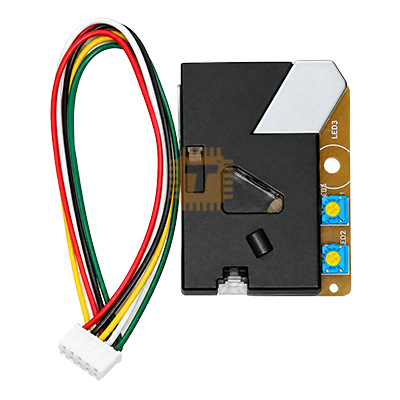
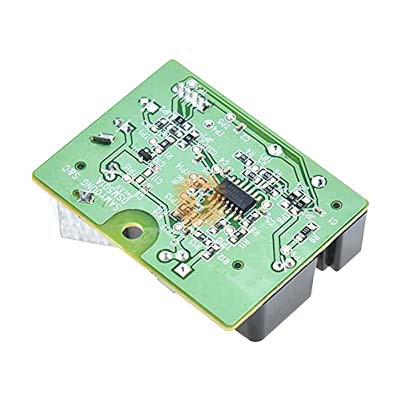
| Name | DSM501B PM2.5 Dust Sensor Air Measurement Module For Arduino |
| Code | MD0184 |
| Price | Rs.3,150.00 |
| In Stock | Yes |
| Package | MODULE |
Product Details
The DSM501B PM2.5 Dust Sensor Air Measurement Module For Arduino is an optical particle sensor engineered for qualitative detection and concentration monitoring of airborne particulate matter, including tobacco smoke, house dust, pollen, and microscopic combustion aerosols down to 1 micrometer in diameter. Operating on the principle of light scattering, the module integrates an infrared emitting diode (IRED) and a photodetector paired with an onboard electric heater that establishes a steady thermal convection current across the sensing chamber. Featuring dual-channel pulse-width modulated (PWM) digital outputs with independent particle sensitivity thresholds (PM2.5 and PM10), it provides a cost-effective, low-maintenance air quality monitoring solution for Arduino, ESP32, STM32, and Raspberry Pi platforms.
Specifications
- Sensor Model / Part Number: DSM501B
- Detection Principle: Optical Light Scattering (Particle Counter / Photometer)
- Measurable Particle Diameter Range: Approx. ≥ 1.0 μm to 2.5 μm (PM2.5) and ≥ 2.5 μm to 10 μm (PM10)
- Detection Particle Concentration Range: 0 to 1.4 mg/m³ (approx. 0 to 500 μg/m³)
- Operating Supply Voltage (VCC): 5.0 V DC (±0.5 V regulated input)
- Current Consumption: Approx. 90 mA max. (Typical ~80 mA with internal heater resistor active)
- Output Signal Type: Dual Open-Collector Digital Pulse Outputs (Active Low: Low Pulse Ratio / LPO)
- Output Logic Voltage Level: 5.0 V TTL Logic (Requires pull-up resistor to VCC)
- Preheating / Warm-Up Stabilization Time: Approx. 1 minute to 3 minutes from cold boot
- Air Sampling Mechanism: Natural Thermal Convection via Integrated Internal Resistor Heater
- Pinout Configuration (Standard 5-Pin Interface):
- Pin 1 (Control / Sensitive Adjustment): Threshold sensitivity control (connect through external resistor or leave open)
- Pin 2 (VOUT2 / Output 2): Pulse output for smaller particles (~1 μm to 2.5 μm / PM2.5)
- Pin 3 (VCC): +5V DC Regulated Power Supply Input
- Pin 4 (VOUT1 / Output 1): Pulse output for larger particles (~2.5 μm to 10 μm / PM10)
- Pin 5 (GND): System Common Ground
- Connector Type: 5-Pin 2.54mm / 2.0mm Pitch JST/Molex Header Socket (includes ribbon wiring pigtail)
- Operating Temperature Envelope: -10°C to +65°C
- Operating Humidity Range: ≤ 95% RH (Non-condensing)
- Module Dimensions: Approx. 59.0 mm × 45.0 mm × 20.0 mm (L × W × H)
- Net Weight: Approx. 25 g to 30 g
Features
- Dual Particle Size Discrimination: Outputs two separate digital pulse lines (VOUT1 and VOUT2), enabling microcontroller firmware to distinguish between coarse dust particles and fine combustion aerosols or tobacco smoke.
- Acoustically Silent Operation: Utilizes an onboard internal heater resistor to induce thermal air convection through the optical chamber, eliminating the mechanical noise, vibration, and motor wear of electric fan pumps.
- Simple Digital Interfacing: Operates via Low Pulse Occupancy (LPO) calculation over a sample time window (typically 30 seconds), eliminating the need for high-resolution analog-to-digital converters (ADCs).
- Broad Compatibility: Plugs directly into 5V microcontroller logic (Arduino Uno, Mega, Leonardo) and interfaces easily with 3.3V boards (ESP32, ESP8266, Raspberry Pi) using a voltage divider or logic level shifter.
- Compact Shielded Form Factor: Enclosed in a compact protective case that shields optical detectors from stray ambient light while keeping internal optics isolated from mechanical contact.
Common Applications
- Indoor Air Quality (IAQ) Monitors: DIY and educational air monitoring stations displaying real-time particulate indices on OLED, LCD, or serial terminals.
- Smart Air Purifiers & Scrubbers: Triggering HEPA filter fan speeds automatically upon detecting elevated smoke, vaping aerosol, or ambient dust levels.
- HVAC & Ventilation Automation: Activating fresh-air intake dampers, exhaust fans, and energy-recovery ventilators (ERVs) when indoor particulate levels spike.
- Smoke & Cigarette Detection Systems: Detecting unauthorized indoor tobacco smoke or kitchen smoke in hospitality and residential environments.
- IoT Environmental Sensor Nodes: Transmitting periodic dust concentration averages to cloud IoT dashboards (ThingsBoard, Blynk, Home Assistant) via Wi-Fi or LoRa.
Usage Tips
- Mounting Orientation Requirement (CRITICAL):
- The module MUST be mounted vertically with the air inlet at the bottom and the outlet at the top.
- Because this sensor relies entirely on thermal convection generated by an internal resistor heater (and has no motorized fan), mounting it horizontally or upside down stalls air circulation through the optical chamber, resulting in zero or inaccurate pulse counts.
- Pull-Up Resistor & Microcontroller Wiring:
- The output pins (VOUT1, VOUT2) feature open-collector configurations. Enable the internal pull-up resistor on your Arduino input pins (`pinMode(pin, INPUT_PULLUP)`) or wire an external 10kΩ pull-up resistor between the output pin and the logic voltage rail.
- If interfacing with 3.3V microcontrollers like an ESP32 or Raspberry Pi, pull up the output lines to the 3.3V rail instead of 5V to prevent logic pin overvoltage damage.
- Measurement Algorithm (Low Pulse Occupancy - LPO):
- Do not read the output pin with a single momentary digital read. Track the total accumulated time the pulse pin remains LOW over a fixed integration window (typically 30 seconds).
- Calculate the Low Pulse Ratio (LPR = Low Occupancy Time / Total Sample Time x 100%) and use a polynomial calibration curve to estimate particle concentration (μg/m³ or 0.01cf).
- Sensor Warm-Up Period: Allow the sensor to operate continuously for at least 1 to 3 minutes after powering up before recording data. This interval is necessary for the heating element to establish a stable, continuous upward thermal air draft through the sensing path.
- Dust & Condensation Protection: Avoid operating the module in environments with heavy steam, oil grease mist, or condensed water vapor, which cause severe optical scattering and permanent fouling of the lens surfaces. For outdoor weather stations, place the unit inside a louvered radiation shield (Stevenson screen) with an insect filter screen.
Sharing is caring, show love and share the product with your friends.
Featured


Add to Cart

Add to Cart
Other Products
Add to Cart
Add to Cart
