
NRF24L01 2.4GHz Wireless Transceiver Module (MD0038) Products


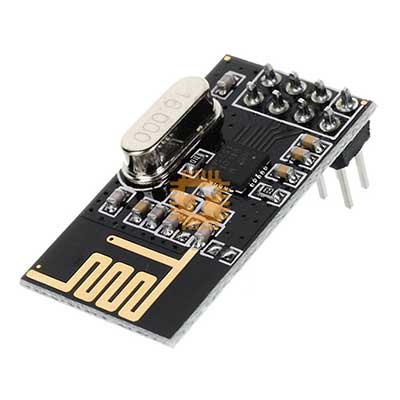

| Name | NRF24L01 2.4GHz Wireless Transceiver Module |
| Code | MD0038 |
| Price | Rs.350.00 |
| In Stock | Yes |
| Package | MODULE |
Product Details
The NRF24L01 is a highly popular, single-chip wireless transceiver operating in the 2.4GHz to 2.5GHz worldwide ISM (Industrial, Scientific, and Medical) band. It is a cost-effective solution designed for low-power, short-range wireless communication, making it a standard choice for DIY electronics, wireless peripherals, and small-scale remote control systems.
Specifications
- Operating Voltage: 1.9V to 3.6V (Low-voltage operation).
- Operating Frequency: 2.4GHz ISM band.
- Transmission Rate: User-selectable at 1Mbps or 2Mbps.
- Communication Range: Up to 100 meters in open areas (at 0dBm transmit power).
- Current Consumption:
- Transmit Mode: 9.0mA (at -6dBm output power).
- Receive Mode: Approx. 12.3mA.
- Output Power: Maximum 0dBm.
- Interface: SPI (Serial Peripheral Interface).
Features
- Enhanced ShockBurst™: Includes an integrated protocol engine that handles high-speed signal processing, such as automatic packet assembly, timing, and error detection.
- Multi-Point Communication: Supports up to six channels of simultaneous data reception, allowing for complex star networks.
- 125 Frequency Points: Provides a wide range of channels to satisfy multi-point and frequency-hopping needs, reducing interference from other 2.4GHz devices.
- Automatic Hardware Handling: Features built-in hardware CRC error detection, automatic packet retransmission for lost data, and automatic acknowledgment (Auto-ACK) signals.
- Low Power Management: Supports power-down and standby modes to significantly reduce current consumption when the radio is not actively transmitting or receiving.
- Ease of Development: The link layer is fully integrated, meaning the module handles the heavy lifting of wireless protocols, allowing for simple interfacing with low-speed microprocessors or standard I/O ports.
Pin Configuration
- VCC: 1.9V – 3.6V (Do not exceed 3.6V).
- GND: Ground.
- CE: Chip Enable (Toggles between standby and active RX/TX modes).
- CSN: SPI Chip Select.
- SCK: SPI Clock.
- MOSI: SPI Master Out Slave In.
- MISO: SPI Master In Slave Out.
- IRQ: Interrupt Request (Optional pin to signal data received or sent).
Common Applications
- Wireless Peripherals: Keyboards, mice, and game controllers.
- Remote Control Systems: Used extensively in toy cars, boats, and simple drones.
- Smart Home Sensors: Low-power temperature, humidity, or motion sensors reporting to a central hub.
- Asset Tracking: Active RFID-style tracking within a limited range.
Usage Tips
- Voltage Caution: While the SPI pins are often 5V tolerant on many boards, the VCC pin must never be connected to 5V. Use a dedicated 3.3V power source.
- Power Filtering: For stable communication, it is highly recommended to solder a small capacitor (e.g., 10uF) directly across the VCC and GND pins on the module to filter out power supply noise.
- Antenna Orientation: Since this module uses a built-in PCB trace antenna, ensure it is not blocked by metal objects or thick enclosures, as this will drastically reduce the 100-meter range.
- Channel Selection: If you experience connection drops, try changing the frequency channel in your code to avoid interference from household WiFi signals.
NOTE: It is highly recommended to use the NRF Socket Adapter with this module.
Reference Tutorial: https://lastminuteengineers.com/nrf24l01-arduino-wireless-communication/
Sharing is caring, show love and share the product with your friends.
Featured

Add to Cart


Add to Cart

Add to Cart
Other Products

Add to Cart
