
NRF24L01+PA+LNA 2.4G Wireless Transceiver Module with SMA Antenna (MD0121) Products
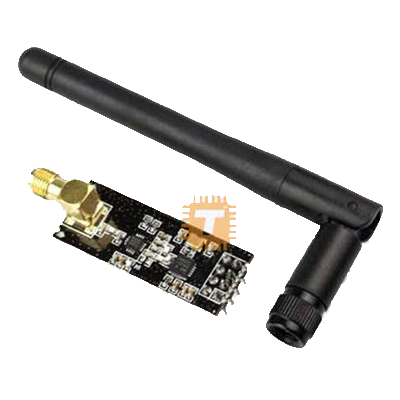
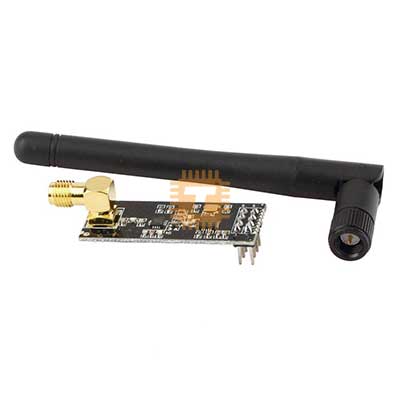
| Name | NRF24L01+PA+LNA 2.4G Wireless Transceiver Module with SMA Antenna |
| Code | MD0121 |
| Price | Rs.700.00 |
| In Stock | Yes |
| Package | MODULE |
Product Details
The NRF24L01+PA+LNA is a high-power version of the standard NRF24L01+ transceiver. By integrating a Power Amplifier (PA) and a Low Noise Amplifier (LNA), this module significantly extends the communication range—up to 1,100 meters in open areas. It is widely used in long-range telemetry, drone control, and wireless sensor networks where a standard PCB antenna would be insufficient.
Specifications
- Operating Voltage: 3.0V to 3.6V (3.3V recommended)
- Operating Frequency: 2.4GHz ISM band
- Max Output Power: +20dBm
- Current Consumption (Peak):
- Transmission (TX): 115mA
- Reception (RX): 45mA
- Power-down Mode: 4.2uA
- PA Gain: 20dB
- LNA Gain: 10dB
- Sensitivity (at 250kbps): -104dBm
- Antenna: External 2dBi SMA antenna (Included)
- Interface: SPI
Range Estimates (Open Area)
| Data Rate | Estimated Range |
| 2Mbps | 520m |
| 1Mbps | 750m |
| 250kbps | 1100m |
Features
- Long-Range Capability: The combination of PA (for stronger transmission) and LNA (for sensitive reception) allows for stable links over distances exceeding one kilometer.
- Multiceiver Support: Hardware support for up to 6 data pipes, allowing one master module to communicate with 6 slave modules simultaneously.
- Standard SPI Interface: Compatible with almost any microcontroller, including Arduino, STM32, and Raspberry Pi.
- Automatic Packet Handling: Built-in features like Auto-ACK and Auto-Retransmit simplify software development and ensure data reliability.
- RF Shielding: The module usually includes a metal shield over the critical RF components to minimize interference and improve performance.
Pin Configuration
- VCC: 3.3V Power (Do not use 5V).
- GND: Ground.
- CE: Chip Enable (Activates RX or TX mode).
- CSN: SPI Chip Select.
- SCK: SPI Clock.
- MOSI: SPI Data Input.
- MISO: SPI Data Output.
- IRQ: Interrupt pin (Optional).
Common Applications
- Long-Range RC Systems: Custom transmitters for RC planes and drones.
- Wireless Telemetry: Sending sensor data from remote outdoor locations to a central hub.
- IoT Gateways: Connecting low-power nodes across a large industrial site or farm.
- Robotics: Real-time wireless control for mobile robots and rovers.
Usage Tips
- Power Stability: This module is very sensitive to power supply noise, especially during the 115mA transmission peaks. Adding a 10uF to 100uF capacitor across the VCC and GND pins of the module is highly recommended to prevent resets and signal drops.
- 3.3V Logic: While the SPI pins are often 5V tolerant on these modules, the VCC must never exceed 3.6V. Using a dedicated 3.3V regulator is safer than relying on an Arduino's 3.3V pin, which may not provide enough current.
- Antenna Safety: Never power the module or attempt to transmit without the SMA antenna connected. Operating without an antenna can reflect power back into the PA and destroy the chip.
- Interference: Since it operates on the 2.4GHz band, it shares space with WiFi and Bluetooth. If you experience poor range, try switching to a different channel (higher channels like 100-125 are often clearer).
NOTE: It is highly recommended to use the NRF Socket Adapter with this module
Reference Tutorial: https://lastminuteengineers.com/nrf24l01-arduino-wireless-communication/
Sharing is caring, show love and share the product with your friends.
Featured


Add to Cart


