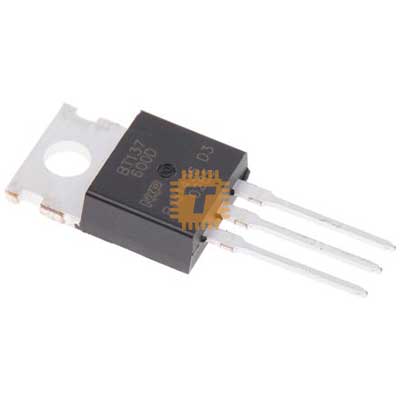
Original BT138 Triac THT (DI0311) Products
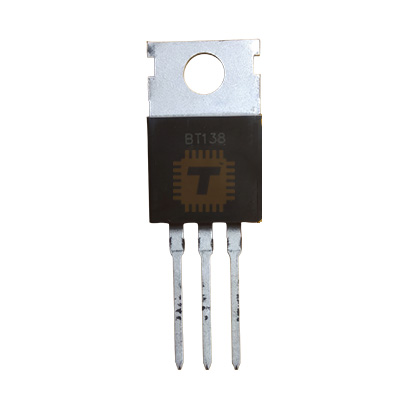
| Name | Original BT138 Triac THT |
| Code | DI0311 |
| Price | Rs.160.00 |
| In Stock | Yes |
| Package | THT |
Product Details
The Original BT138 Series 12A Triac (Through-Hole TO-220AB) is a high-performance, planar passivated four-quadrant bidirectional thyristor manufactured for general-purpose AC power switching and phase-control applications. Encapsulated in an industry-standard through-hole TO-220AB package, it is rated for a continuous RMS on-state current of 12A with high repetitive peak off-state voltage blocking capabilities (typically 600V or 800V depending on the specific variant, such as BT138-600 or BT138-800). Featuring high thermal cycling performance, high surge current handling up to 100A, and reliable bidirectional gate triggering across all four quadrants (Q1–Q4), the BT138 is widely utilized in domestic and industrial AC motor speed controllers, light dimmers, heating element regulators, solid-state relays (SSRs), and static AC switching circuits.
Specifications
- Part Number / Series: BT138 Series (BT138-600 / BT138-600E / BT138-800)
- Semiconductor Type: Planar Passivated 4-Quadrant Triac (Bidirectional Thyristor)
- Package Type: TO-220AB (Plastic 3-Lead Through-Hole Package with Metal Mounting Tab)
- Repetitive Peak Off-State Voltage ($V_{DRM}$): 600V (BT138-600) / 800V (BT138-800)
- RMS On-State Current ($I_{T(RMS)}$): 12 A (at $T_{mb} \le 99^\circ\text{C}$, full sine wave)
- Non-Repetitive Peak On-State Surge Current ($I_{TSM}$): 95 A (at 50 Hz, $t_p = 20\text{ms}$) / 105 A (at 60 Hz, $t_p = 16.7\text{ms}$)
- $I^2t$ for Fusing: 45 $A^2s$ ($t_p = 10\text{ms}$)
- Gate Trigger Current ($I_{GT}$):
- Standard Series: Typ. 10 mA to 35 mA (Max. 35 mA in Q1, Q2, Q3; Max. 70 mA in Q4)
- Sensitive Gate "E" Series (BT138-600E): Max. 10 mA in Q1, Q2, Q3; Max. 25 mA in Q4
- Gate Trigger Voltage ($V_{GT}$): Typ. 0.7 V to 1.0 V (Max. 1.5 V at $V_D = 12\text{V}$, $T_j = 25^\circ\text{C}$)
- Holding Current ($I_H$): Typ. 15 mA to 30 mA (Max. 45 mA to 60 mA)
- Latching Current ($I_L$): Typ. 20 mA to 45 mA
- Peak On-State Voltage Drop ($V_T$): Typ. 1.4 V (Max. 1.65 V at $I_T = 15\text{A}$)
- Critical Rate of Rise of Off-State Voltage ($dV/dt$): Min. 100 V/µs to 250 V/µs (at $T_j = 125^\circ\text{C}$)
- Critical Rate of Rise of On-State Current ($dI/dt$): 50 A/µs
- Thermal Resistance (Junction to Mounting Base, $R_{th(j-mb)}$): 1.5 K/W
- Thermal Resistance (Junction to Ambient in Free Air, $R_{th(j-a)}$): 60 K/W
- Operating Junction Temperature ($T_j$): -40°C to +125°C
- Storage Temperature Range ($T_{stg}$): -40°C to +150°C
- Pinout Configuration (TO-220AB - Front View, Pins Facing Down):
- Pin 1: Main Terminal 1 (MT1 / T1) - Reference Terminal
- Pin 2: Main Terminal 2 (MT2 / T2) - Connected internally to Metal Mounting Tab
- Pin 3: Gate (G) - Control Trigger Terminal
- Mounting Tab: Electrically connected to Pin 2 (MT2)
Features
- High 12A Continuous Current Handling: Capable of driving mid-to-high power AC loads such as universal brush motors, heavy heating elements, and large lighting arrays.
- Planar Passivated Die Structure: Delivers high voltage blocking reliability, excellent stability at elevated temperatures, and superior long-term performance under continuous duty.
- Four-Quadrant Triggering (Q1–Q4): Allows flexible gate triggering from positive or negative drive voltages, simplifying analog trigger and digital optoisolated driver designs.
- High Surge Capability: Handles peak inrush currents up to 100A, providing resilience against motor startup surges and cold incandescent filament inrush.
- Industry-Standard TO-220AB Package: Rugged through-hole footprint easily attaches to aluminum heatsinks for high-dissipation thermal management.
Common Applications
- AC Motor Speed Regulation: Universal motor speed controllers for power tools, washing machines, fans, blenders, and vacuum cleaners.
- Phase-Controlled Dimming & Heating: Leading-edge phase-cut light dimmers, temperature regulation in ovens, soldering stations, and industrial heaters.
- Solid-State Relays (SSRs): Contactless AC mains switching with zero contact bounce, no acoustic noise, and long operating life.
- Home Appliance Control: Solenoid valve actuation, pump drivers, and AC heating element switching in white goods.
- Microcontroller Mains Interfacing: Safe AC load switching from Arduino, ESP32, or PIC microcontrollers via zero-cross or random-phase optocouplers (e.g., MOC3021, MOC3041).
Usage Tips
- Heatsink & Thermal Interface (Mandatory for High Current): At continuous loads above **2A to 3A**, the triac generates significant heat ($P \approx V_T \times I_T \approx 1.5\text{V} \times I$). Always mount the TO-220AB package to an adequately sized aluminum heatsink using thermal paste.
- Tab Electrical Isolation: The metal mounting tab is **internally connected to Pin 2 (MT2)**, which carries AC mains potential. Use an insulating mica/silicone pad and an insulating bushing on the mounting screw if the heatsink is connected to chassis ground.
- Snubber Network for Inductive Loads: When controlling inductive loads (motors, transformers, solenoids), the phase lag between voltage and current can cause high commutating $dV/dt$, leading to false re-triggering. Place an **RC snubber circuit (e.g., 39Ω to 100Ω 1W resistor in series with a 100nF 400V/630V film capacitor)** directly across MT1 and MT2.
- Gate Optoisolation: To control the triac safely from a low-voltage microcontroller (Arduino, ESP32), isolate the gate circuit using a triac-driver optocoupler (e.g., **MOC3041 for zero-crossing on/off switching** or **MOC3021 for phase-angle dimming/speed control**).
- Gate Resistor Sizing: Connect a damping/limiting resistor (typically **220Ω to 330Ω**, 1/2W) in series with the gate and the optocoupler output to limit peak gate current during turn-on.
Sharing is caring, show love and share the product with your friends.
Featured

Add to Cart

Add to Cart

Add to Cart