Original HGSEMI L9110S BI- Directional Motor Driver (IC0356) Products
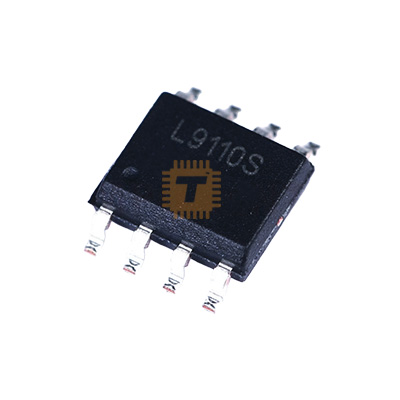
| Name | Original HGSEMI L9110S BI- Directional Motor Driver |
| Code | IC0356 |
| Price | Rs.60.00 |
| In Stock | Yes |
Product Details
The HGSEMI L9110S is a compact, discrete, monolithic integrated circuit designed for driving and controlling small DC motors and stepper motors. Utilizing an integrated low-saturation H-Bridge push-pull amplifier configuration, this original chip from HGSEMI provides seamless bi-directional (forward and reverse) speed and directional control. It is widely used in low-voltage robotics, smart toys, and electronic valve controllers due to its minimal peripheral component requirements and highly efficient current handling in a small footprint.
Specifications
- Manufacturer: HGSEMI (Original)
- Package Options: Available in standard SOP8 (surface mount) or DIP8 (through-hole) form factors
- Operating Voltage Range (Vcc): 2.5V to 12V DC (Optimized for battery-powered setups like 3.7V Li-ion or 4x AA packs)
- Continuous Output Current: Up to 800mA (0.8A) per channel
- Peak Output Current: Up to 1.5A - 2.0A (Brief surge current capability)
- Logic Level Inputs: Fully compatible with 3.3V and 5V logic rails (Directly interfaces with Arduino, ESP32, and Raspberry Pi)
- Output Saturation Drop: Low voltage drop across internal output transistors (Vce(sat))
- Standby Current: Extremely low (≤ 2uA) when control pins are held low
Features
- Built-In Clamp Flyback Diodes: The chip features internal protection diodes across the output channels. When inductive loads like motors are suddenly turned off, the massive inverse voltage spike is safely dumped back into the power rails, eliminating the need for external discrete snubber components.
- Low Armature On-Resistance: Engineered to minimize internal thermal dropouts. This keeps the IC remarkably cool during normal 500mA continuous operation and ensures maximum voltage is delivered directly to the motor windings.
- Uncommitted Channels: Because each chip controls one single DC motor independently, it isolates inductive motor noise to its local line, making multi-motor layouts cleaner to trace than bulky, shared dual-driver modules.
- Anti-Cross Conduction Protection: The internal control logic prevents both the top and bottom transistors of the H-bridge branch from turning on at the exact same millisecond, preventing internal short-circuits (shoot-through).
Common Applications
- Smart Toy Robotics: Driving the small yellow dual-shaft gear motors found in 2WD and 4WD smart robot car kits.
- Motorized Valve Actuators: Operating automated domestic gas or water main line shut-off valves.
- Automatic Paper Dispensers: Controlling the low-voltage dispensing gears inside automated hand-towel and soap machines.
- Compact Stepper Driver: Wiring two distinct L9110S chips together in parallel allows you to completely drive a single 4-wire bipolar stepper motor (such as a tiny Nema 8 or miniature 28BYJ-48 variant).
Installation & System Tuning Tips
- Ground Uniformity is Mandatory: Always connect the ground (
GND) pin of your microcontroller (e.g., Arduino) to theGNDpin of the L9110S driver circuit. If you omit this shared reference path, the control logic lines will float randomly, causing the motor to stutter or misfire. - Decoupling Capacitors: Motors generate high-frequency inductive electrical noise back down the power tracks. Always place a 0.1uF ceramic capacitor directly across the physical terminals of the DC motor, along with a 100uF electrolytic capacitor across the main
VCCandGNDlines near the chip. This filters noise spikes that could reset your nearby microcontroller. - Do Not Stride Past Stall Tolerances: Avoid using the L9110S to drive motors that stall out above 1.5A (such as heavy standard-sized 12V 775 motors). If a heavy load jams the output shaft, the chip will enter a thermal over-stress state rapidly and can fail permanently. Stick to 130-class, 260-class, and small micro metal gearmotors.
Sharing is caring, show love and share the product with your friends.
Featured

Add to Cart

Add to Cart
Add to Cart