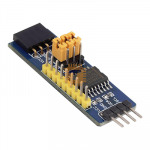
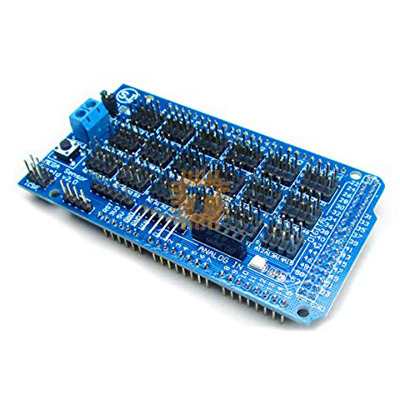
The PCF8574T I/O Expansion Board is designed to act as a remote 8-bit I/O expander for the I2C-bus. It allows you to expand the digital pins of your microcontroller using only two wires for communication. This specific module is optimized for cascading, featuring both a pin header and a connector on opposite sides to easily daisy-chain multiple boards together.
Specifications
Chip: PCF8574.
Interface: I2C-bus.
I/O Ports: 8-bit parallel port.
Operating Voltage: 2.5V to 6V DC.
Expansion Limit: Up to 8 boards can be connected to the same I2C-bus.
Total I/O Potential: Provides up to 64 I/O ports when fully cascaded.
Features
Cascading Design: The board features an I2C pin header on one side and an I2C connector on the other, making it highly flexible to connect to your development system.
Multi-Module Support: Supports I2C cascading, allowing multiple modules to be used on the bus simultaneously by connecting headers and connectors in sequence.
Address Configuration: Uses onboard jumpers (typically A0, A1, A2) to set the unique I2C address for each board, ensuring no conflicts occur during cascading.
Quasi-bidirectional I/O: Each of the 8 pins can be used as an input or output without a direction control signal.
Pin and Header Definition
VCC / GND: Power supply and ground.
SDA / SCL: I2C Serial Data and Serial Clock lines.
P0 - P7: The 8 extended parallel I/O pins.
Address Jumpers: Pins A0, A1, and A2 used to define the hardware address.
Common Applications
Pin-Limited Microcontrollers: Adding digital I/O to boards like the ESP8266 or small ATtiny chips.
Character LCDs: Driving 16x2 or 20x4 LCD screens using the I2C interface.
Keypad Scanning: Interfacing with 4x4 matrices while saving MCU pins.
LED Control: Managing multiple status indicators or relays.
Usage Tips
Daisy-Chaining: When cascading, ensure each module is assigned a unique address via the jumpers; otherwise, the microcontroller will not be able to distinguish between boards.
Pull-up Resistors: I2C communication requires pull-up resistors. While these modules often include them, keep an eye on the total resistance if you chain many boards together.
Interrupt Pin: The PCF8574 includes an "INT" (Interrupt) output that signals the MCU when any input state changes, allowing for efficient, event-driven programming.
Sharing is caring, show love and share the product with your friends.