
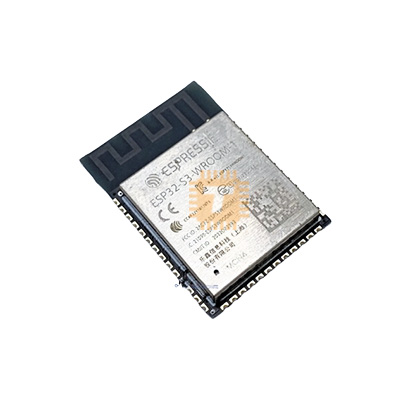
ESP32-S3-WROOM-1-N4 Chip 4MB WiFi Bluetooth IoT (MD1021) Products
We are sorry but the product is out of stock, please check back after few days.
| Name | ESP32-S3-WROOM-1-N4 Chip 4MB WiFi Bluetooth IoT |
| Code | MD1021 |
| Price | Rs.1,480.00 |
| In Stock | No |
| Package | MODULE |
Product Details
The ESP32-S3-WROOM-1-N4 is a high-performance, general-purpose Wi-Fi and Bluetooth Low Energy (BLE) microcontroller module engineered by Espressif Systems. Powered by the ESP32-S3 series of chips, it features a powerful 32-bit Xtensa dual-core processor alongside specialized vector instructions designed to accelerate artificial intelligence (AI), machine learning (ML), and neural network workloads at the edge. Outfitted with 4MB of onboard SPI Flash (N4 variant) and an integrated PCB trace antenna, this module serves as the primary processing engine for modern IoT architectures, smart home systems, and industrial automation networks.
Specification
- Core Processor: Xtensa 32-bit LX7 dual-core processor running at up to 240MHz
- Vector Extensions: Integrated AI/Neural Network vector instructions for accelerated edge computing
- Memory Architecture:
- Internal SRAM: 512 KB
- Internal ROM: 384 KB
- On-Board SPI Flash: 4MB (N4 variant)
- PSRAM: None (0 MB internal PSRAM included in the N4 base configuration)
- Wireless Connectivity:
- Wi-Fi: 802.11 b/g/n (2.4GHz) up to 150Mbps
- Bluetooth: Bluetooth 5.0 LE (Low Energy) with long-range and mesh networking support
- Antenna Style: On-board integrated PCB trace antenna
- Operating Voltage (VDD): 3.0V to 3.6V (Typical: 3.3V)
- Peripherals & I/O: 45 programmable GPIOs featuring SPI, I2C, UART, PWM, I2S, 12-bit ADC, and a full-speed USB On-The-Go (OTG) interface
Features
- AI and Machine Learning Hardware Acceleration: The dual-core LX7 processor includes native support for 8-bit, 16-bit, and 32-bit vector calculations. This allows the module to run tiny machine learning models locally (TinyML) for applications such as offline wake-word detection, object recognition, and voice commands.
- Comprehensive Multi-Protocol Wireless Engine: Combines long-range 2.4GHz Wi-Fi with Bluetooth LE 5.0. Bluetooth 5 allows for high data rates or long-range extensions, enabling easy smartphone provisioning during configuration before seamlessly shifting connection tasks to the local Wi-Fi router.
- Native USB On-The-Go (OTG) Interfaces: The chip features internal hardware interfaces for full-speed USB 1.1, allowing developers to configure the chip directly as a USB human interface device (keyboard/mouse), a virtual COM port for debugging, or a USB mass storage drive without requiring an external USB-to-UART bridge chip.
- Robust Hardware Security Infrastructure: Built with robust corporate security features, including secure boot verification, flash encryption, cryptographic hardware accelerators (AES-128/256, RSA, ECC, SHA), and a dedicated Random Number Generator (RNG).
Common Applications
- Edge AI & Speech Recognition: Powering offline smart voice controllers, wake-word recognition boxes, and basic camera-based vision recognition nodes.
- Industrial Automation & Remote Telemetry: Deploying local sensor gateways, Modbus/RS485 wireless bridges, and environment tracking nodes that push telemetry to cloud frameworks via MQTT or WebSockets.
- Smart Home Automation Ecosystems: Serving as the primary processor for custom Wi-Fi relays, smart lighting matrices, automated appliance switches, and Matter-compliant smart home infrastructure devices.
- Robotics & Teleoperation Controllers: Serving as a high-speed wireless processing board for mobile robot telemetry, Wi-Fi/BLE tank controllers, and localized multi-sensor arrays.
Engineering & Development Tips
- Implement a Stable Power Supply: The ESP32-S3 wireless engine exhibits sharp current consumption spikes exceeding 400 - 500mA during Wi-Fi calibration routines or data transmission cycles. Ensure your 3.3V voltage regulator circuit can supply a minimum continuous output of 1A. Place a bulk electrolytic capacitor (approx 100 μF) in parallel with a ceramic decoupling capacitor (0.1 μF) close to the module’s VDD pin to suppress power rail sagging.
- Antenna Clearance Zones: Keep the PCB trace antenna extended over the edge of your mother-board or design a wide keep-out zone beneath it. Do not run copper planes, power traces, or component ground fills under or immediately adjacent to the antenna area. Shielding the antenna with ground copper or housing it inside a fully enclosed metal container will severely degrade your wireless range and transmission stability.
- Manage Memory Optimization (Flash vs. PSRAM): The N4 variant provides a rigid 4MB of flash memory and 0MB of external PSRAM. When working in development environments like Arduino IDE, ESP-IDF, or MicroPython, ensure your partition tables are appropriately mapped to fit your firmware. If your code handles large memory buffers (such as camera video streaming streams or intensive web page hosting buffers), optimize your variables inside internal SRAM to avoid running out of memory heap allocations.
- Leverage Native USB Pins for Debugging: GPIO 19 (D-) and GPIO 20 (D+) map directly to the internal USB controller. You can solder a USB cable directly to these pins for direct programming and serial debugging, completely bypassing the need for a traditional external CP2102 or CH340 USB-to-UART IC.
Sharing is caring, show love and share the product with your friends.
Featured
Add to Cart

Add to Cart

Add to Cart

Add to Cart
Other Products

Add to Cart

Add to Cart
