IR Infrared Remote Decoder Encoder Module 5V (MD1036) Products
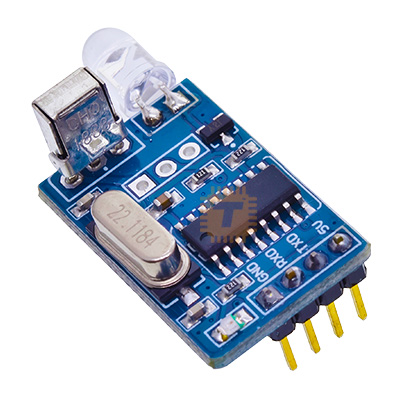
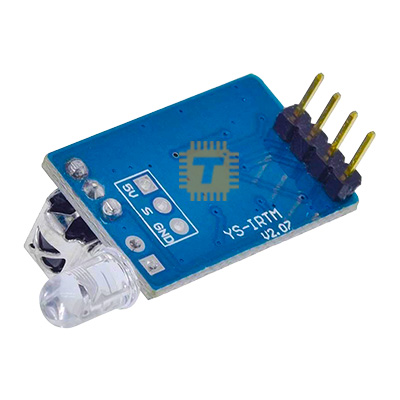
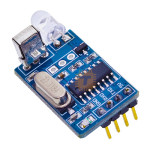
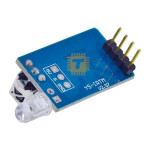
| Name | IR Infrared Remote Decoder Encoder Module 5V |
| Code | MD1036 |
| Price | Rs.600.00 |
| In Stock | Yes |
| Package | MODULE |
Product Details
The 5V IR Infrared Remote Decoder / Encoder Module is a smart communication bridge designed to simplify infrared (IR) wireless remote control protocols. Powered by an onboard microcontroller (often the STM8 or a dedicated hardware decoder IC), this module handles the complex timing loops of encoding and decoding infrared wave packets. It interfaces transparently with host controllers (like Arduino, Raspberry Pi, or ESP32) using standard UART serial communication, turning infrared signals into simple hex data bytes.
Specification
- Onboard Processor Engine: Integrated microcontroller pre-loaded with hardware IR encoding/decoding firmware
- Communication Interface Standard: Digital UART Serial (TTL logic levels)
- Default Baud Rate: 9600 bps (Standard configuration: 8 Data Bits, 1 Stop Bit, No Parity)
- Operating Input Voltage (VCC): DC 5.0V (± 5%)
- Operating Current Profile:
- Idle Mode: ≤ 5mA continuous current draw
- Active IR Transmit Pulses: Up to 50mA peak current loop during flash sequences
- Carrier Frequency Range: Standard 38 kHz modulation (Matches 95% of consumer electronics remotes)
- Supported Protocols: NEC Protocol format (widely adopted by standard remote controllers)
- Effective Wireless Distance: 6 to 10 meters (approx 20 to 33 feet depending on alignment and line-of-sight)
- Connection Profile: 4-Pin standard 2.54mm header array
Features
- Dual-Function Transceiver Array: Combines a high-sensitivity integrated IR receiver head (shielded against ambient light clutter) and a high-power wide-angle IR transmitter LED on a single compact board layout.
- Transparent Hardware Decoding: Offloads processing tasks completely. The onboard MCU acts as a dedicated co-processor, converting raw analog optical pulses into clean 3-to-4 byte serial hexadecimal arrays (User Code + Command Code), preventing main code execution delays on the host microcontroller.
- Simple Serial Control Mapping: Eliminates the need for heavy, memory-consuming software libraries like
IRremote. Sending data out via an infrared light path is as easy as executing a basicSerial.print()command in your code. - Compact, Breadboard-Ready Footprint: Fits into space-constrained DIY boxes, smart home prototypes, and robotic chassis enclosures without adding bulk or mechanical mounting friction.
Common Applications
- Smart Home Appliance Integration: Linking microcontrollers to commercial, non-smart hardware devices to automate television power tracking, stereo audio volume adjustments, or air conditioner climate adjustments over local Wi-Fi networks.
- Universal Remote Clone Tools: Constructing custom learning remote tools that sample arbitrary remote button presses and store the hex arrays to replicate the commands later.
- Robotics Teleoperation Control: Utilizing low-cost, multi-button handheld IR remote keys to steer mobile rovers, toggle mechanical claw relays, and switch speed modes wirelessly.
- Industrial Panel Isolators: Setting up non-contact, optically isolated wireless control inputs across highly dangerous or environmentally sealed industrial testing panels.
Professional Usage & Integration Tips
- Observe Cross-Serial UART Wiring Layout: When interfacing the module with a host development board, ensure your serial communication tracks are cross-connected appropriately:
- Microcontroller
TX-> ModuleRXD - Microcontroller
RX-> ModuleTXD
- Microcontroller
- Check Microcontroller Logic Level Compatibility: The module runs on a 5V rail and operates using 5V TTL serial logic levels. If you are linking this module to a modern 3.3V processing platform (such as an ESP32, Raspberry Pi, or STM32 controller), you must place a logic level shifter or a simple passive resistor voltage divider inline along the module's
TXDpin path. This drops the signal voltage down to a safe 3.3V threshold to prevent damaging the host board's I/O pins. - Understand the Serial Transmission Format: When transmitting an IR signal via the serial line, the module typically expects a strict data sequence (often 5 bytes total), consisting of a fixed execution command header byte (e.g.,
0xA1), the target device address bytes, and the specific data command byte. Review your specific board's factory instruction manual to confirm the data framing sequence before structuring your code arrays. - Ensure Line-of-Sight and Physical Alignment: Infrared light is directional and cannot pass through solid obstacles like walls, cabinets, or plastic enclosures. When designing structural enclosures for your project, ensure that the bulb tips of both the clear IR transmitter LED and the black IR receiver head protrude completely outside the chassis and point directly toward your target electronics array to maximize transmission range and prevent dead zones
Sharing is caring, show love and share the product with your friends.
Featured


Add to Cart